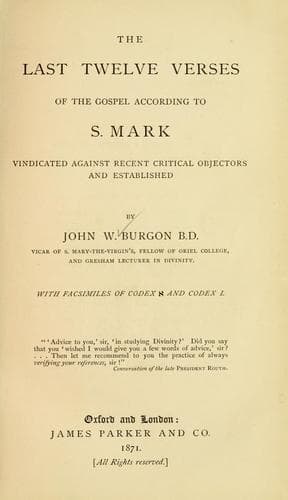
The Last Twelve Verses of the Gospel According to S. MarkBurgon, John William
Religion
The Last Twelve Verses of the Gospel According to S. Mark
Burgon, John William
Bible. Mark XVI, 9-20 -- Criticism, Textual
It is plain that the preceding enumeration could not have been made at any
earlier period: for the Epiphany of our SAVIOUR and His Nativity were
originally but one Festival.(369) Moreover, the circumstances are well
known under which Chrysostom (A.D. 386) announced to his Eastern auditory
that in conformity with what had been correctly ascertained at Rome, the
ancient Festival was henceforth to be disintegrated.(370) But this is not
material to the present inquiry. We know that, as a matter of fact, “the
Epiphanies” (for τὰ ἐπιφανία is the name of the Festival) became in
consequence distributed over Dec. 25 and Jan. 5: our LORD’S _Baptism_
being the event chiefly commemorated on the latter anniversary,(371)—which
used to be chiefly observed in honour of His _Birth_(372)—Concerning the
Lessons for Passion-tide and Easter, as well as concerning those for the
Nativity and Epiphany, something has been offered already; to which may be
added that Hesychius, in the opening sentences of that “Homily” which has
already engaged so much of our attention,(373) testifies that the
conclusion of S. Mark’s Gospel was in his days, as it has been ever since,
one of the lections for Easter. He begins by saying that the Evangelical
narratives of the Resurrection were read on the Sunday night; and proceeds
to reconcile _S. Mark’s_ with the rest.—Chrysostom once and again adverts
to the practice of discontinuing the reading of the Acts after
Pentecost,(374)—which is observed to be also the method of the
Lectionaries.
III. I speak separately of the Festival of the Ascension, for an obvious
reason. It ranked, as we have seen, in the estimation of Primitive
Christendom, with the greatest Festivals of the Church. Augustine, in a
well-known passage, hints that it may have been of Apostolical
origin;(375) so exceedingly remote was its institution accounted in the
days of the great African Father, as well as so entirely forgotten by that
time was its first beginning. I have to shew that in the Great Oriental
Lectionary (whether of the Greek or of the Syrian Church) the last Twelve
Verses of S. Mark’s Gospel occupy a conspicuous as well as a most
honourable place. And this is easily done: for,
(_a_) The Lesson for Matins _on Ascension-Day_ in the East, in the oldest
documents to which we have access, consisted (as now it does) of _the last
Twelve Verses_,—neither more nor less,—of S. Mark’s Gospel. At the Liturgy
on Ascension was read S. Luke xxiv. 36-53: but at Matins, S. Mark xvi.
9-20. The witness of the “Synaxaria” is constant to this effect.
Public-domain text, read in full here on John Shaqi.
Reviews
Reviews
No reviews yet
Be the first to share your thoughts on this work.
Elsewhere in the archive
Join the Discussion
Join the discussion
Sign in to leave a comment or review.
Sign InorCreate an account