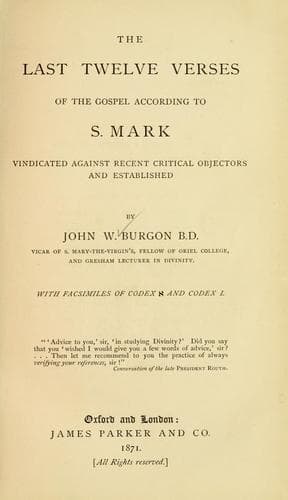
The Last Twelve Verses of the Gospel According to S. MarkBurgon, John William
Religion
The Last Twelve Verses of the Gospel According to S. Mark
Burgon, John William
Bible. Mark XVI, 9-20 -- Criticism, Textual
_He_ knows wondrous little about this department of Sacred Science who can
require to be informed that such a weight of _public_ testimony as this to
the last Twelve Verses of a Gospel is simply overwhelming. The single
discovery that in the age of Augustine [385-430] this portion of S. Mark’s
Gospel was unquestionably read at Easter in the Churches of Africa, added
to the express testimony of the Author of the 2nd Homily on the
Resurrection, and of the oldest Syriac MSS., that they were also read by
the Orientals at Easter in the public services of the Church, must be held
to be in a manner decisive of the question.
Let the evidence, then, which is borne by Ecclesiastical usage to the
genuineness of S. Mark xvi. 9-20, be summed up, and the entire case caused
again to pass under review.
(1.) That Lessons from the New Testament were publicly read in the
assemblies of the faithful according to a definite scheme, and on an
established system, _at least_ as early as the fourth century,—has been
shewn to be a plain historical fact. Cyril, at Jerusalem,—(and by
implication, his namesake at Alexandria,)—Chrysostom, at Antioch and at
Constantinople,—Augustine, in Africa,—all four expressly witness to the
circumstance. In other words, there is found to have been _at least at
that time_ fully established throughout the Churches of Christendom a
Lectionary, which seems to have been essentially one and the same in the
West(390) and in the East. That it must have been of even Apostolic
antiquity may be inferred from several considerations. But that it dates
its beginning from a period _anterior to the age of __ Eusebius,—which is
the age of Codices B and_ א,—at least admits of _no_ controversy.
(2.) Next,—Documents of the vith century put us in possession of the great
Oriental Lectionary as it is found at that time to have universally
prevailed throughout the vast unchanging East. In other words, several of
the actual Service Books, in Greek and in Syriac,(391) have survived the
accidents of full a thousand years: and rubricated copies of the Gospels
carry us back three centuries further. The entire agreement which is
observed to prevail among these several documents,—added to the fact that
when tested by the allusions incidentally made by Greek Fathers of the
ivth century to what was the Ecclesiastical practice of their own time,
there are found to emerge countless as well as highly significant notes of
correspondence,—warrants us in believing, (in the absence of testimony of
any sort to the contrary,) that the Lectionary we speak of differs in no
essential respect from that system of Lections with which the Church of
the ivth century was universally acquainted.
Public-domain text, read in full here on John Shaqi.
Reviews
Reviews
No reviews yet
Be the first to share your thoughts on this work.
Elsewhere in the archive
Join the Discussion
Join the discussion
Sign in to leave a comment or review.
Sign InorCreate an account