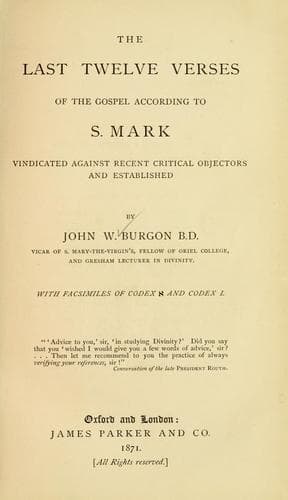
The Last Twelve Verses of the Gospel According to S. MarkBurgon, John William
Religion
The Last Twelve Verses of the Gospel According to S. Mark
Burgon, John William
Bible. Mark XVI, 9-20 -- Criticism, Textual
Nothing scarcely is more forcibly impressed upon us in the course of the
present inquiry than the fact, that documents alone are wanting to make
_that_ altogether demonstrable which, in default of such evidence, must
remain a matter of inevitable inference only. The forms we are pursuing at
last disappear from our sight: but it is only the mist of the early
morning which shrouds them. We still hear their voices: still track their
footsteps: know that others still see them, although we ourselves see them
no longer. We are sure that _there they still are_. Moreover they may yet
reappear at any moment. Thus, there exist Syriac MSS. of the Gospels of
the viith and even of the vith century, in which the Lessons are
rubricated in the text or on the margin. A Syriac MS. (of part of the Old
T.) is actually _dated_ A.D. 464.(392) Should an Evangelium of similar
date ever come to light of which the rubrication was evidently by the
original Scribe, the evidence of the Lectionaries would at once be carried
back full three hundred years.
But in fact we stand in need of no such testimony. Acceptable as it would
be, it is plain that it would add no strength to the argument whatever. We
are already able to plant our footsteps securely in the ivth and even in
the iiird century. It is not enough to insist that inasmuch as the
Liturgical method of Christendom was at least fully established in the
East and in the West at the close of the ivth century, it therefore must
have had its beginning at a far remoter period. Our two oldest Codices (B
and א) bear witness throughout to the corrupting influence of a system
which was evidently in full operation before the time of Eusebius. And
even this is not all. The readings in Origen, and of the earliest versions
of the Gospel, (the old Latin, the Syriac, the Egyptian versions,) carry
back our evidence on this subject unmistakably to _the age immediately
succeeding that of the Apostles_. This will be found established in the
course of the ensuing Chapter.
Beginning our survey of the problem at the opposite end, we arrive at the
same result; with even a deepened conviction that in its essential
structure, the Lectionary of the Eastern Church must be of truly primitive
antiquity: indeed that many of its leading provisions must date back
almost,—nay _quite_,—to the Apostolic age. From whichever side we approach
this question,—whatever test we are able to apply to our premisses,—our
conclusion remains still the very same.
(3.) Into this Lectionary then,—so universal in its extent, so consistent
in its witness, so Apostolic in its antiquity,—“_the_ LAST TWELVE VERSES
_of the Gospel according to S. Mark_” from the very first are found to
have won for themselves not only an entrance, a lodgment, an established
place; but, _the place of highest honour_,—an audience on two of the
Church’s chiefest Festivals.
The circumstance is far too important, far too significant to be passed by
without a few words of comment.
Public-domain text, read in full here on John Shaqi.
Reviews
Reviews
No reviews yet
Be the first to share your thoughts on this work.
Elsewhere in the archive
Join the Discussion
Join the discussion
Sign in to leave a comment or review.
Sign InorCreate an account