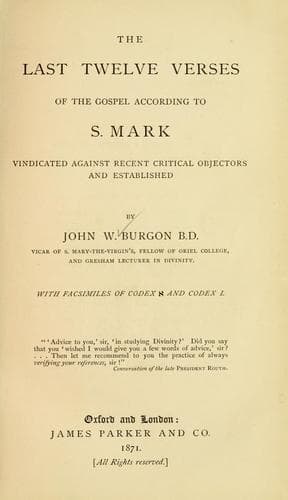
The Last Twelve Verses of the Gospel According to S. MarkBurgon, John William
Religion
The Last Twelve Verses of the Gospel According to S. Mark
Burgon, John William
Bible. Mark XVI, 9-20 -- Criticism, Textual
For it is not here, (be it carefully observed,) as when we appeal to some
Patristic citation, that the recognition of a phrase, or a verse, or a
couple of verses, must be accepted as a proof that the same ancient Father
recognised the context also in which those words are found. Not so. _All
the Twelve Verses in dispute are found in every known copy_ of the
venerable Lectionary of the East. _Those same Twelve Verses_,—neither more
nor less,—_are observed to constitute one integral Lection_.
But even this is not all. The most important fact seems to be that to
these Verses has been assigned a place of the highest possible
distinction. It is found that, from the very first, S. Mark xvi. 9-20 has
been everywhere, and by all branches of the Church Catholic, claimed for
_two_ of the Church’s greatest Festivals,—Easter and Ascension. A more
weighty or a more significant circumstance can scarcely be imagined. To
suppose that a portion of Scripture singled out for such extraordinary
honour by the Church universal is a spurious addition to the Gospel, is
purely irrational; is simply monstrous. No unauthorized “fragment,”
however “remarkable,” could by possibility have so established itself in
the regards of the East and of the West, from the very first. No suspected
“addition, placed here in very early times,” would have been tolerated in
the Church’s solemn public Service six or seven times a-year. No. _It is
impossible._ Had it been one short clause which we were invited to
surrender: a verse: two verses: even three or four:—the plea being that
(as in the case of the celebrated _pericopa de adulterâ_) the Lectionaries
knew nothing of them:—the case would have been entirely different. But for
any one to seek to persuade us that these Twelve Verses, which exactly
constitute one of the Church’s most famous Lections, are every one of them
spurious:—that the fatal taint begins with the first verse, and only ends
with the last:—_this_ is a demand on our simplicity which, in a less
solemn subject, would only provoke a smile. We are constrained to testify
astonishment and even some measure of concern. Have the Critics then,
(supposing them to be familiar with the evidence which has now been set
forth so much in detail;)—Have the Critics then, (we ask) utterly taken
leave of their senses? or do they really suppose that we have taken leave
of ours?
Public-domain text, read in full here on John Shaqi.
Reviews
Reviews
No reviews yet
Be the first to share your thoughts on this work.
Elsewhere in the archive
Join the Discussion
Join the discussion
Sign in to leave a comment or review.
Sign InorCreate an account