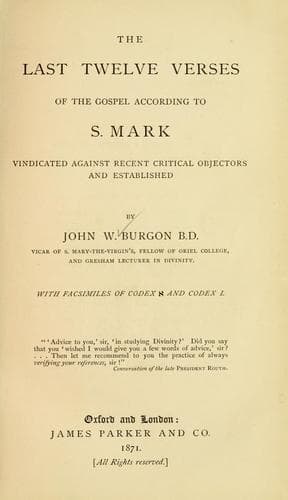
The Last Twelve Verses of the Gospel According to S. MarkBurgon, John William
Religion
The Last Twelve Verses of the Gospel According to S. Mark
Burgon, John William
Bible. Mark XVI, 9-20 -- Criticism, Textual
It is time to close this discussion. It was declared at the outset that
the witness of the Lectionaries to the genuineness of these Verses, though
it has been generally overlooked, is the most important of any: admitting,
as it does, of no evasion: being simply, as it is, decisive. I have now
fully explained the grounds of that assertion. I have set the Verses,
which I undertook to vindicate and establish, on a basis from which it
will be found impossible any more to dislodge them. Whatever Griesbach,
and Tischendorf, and Tregelles, and the rest, may think about the
matter,—the Holy Eastern Church in her corporate capacity, has never been
of their opinion. _They_ may doubt. _The ante-Nicene Fathers_ at least
never doubted. If “the last Twelve Verses” of S. Mark were _deservedly_
omitted from certain Copies of his Gospel in the ivth century, utterly
incredible is it that these same TWELVE VERSES should have been
disseminated, by their authority, throughout Christendom;—read, by their
command, in all the Churches;—selected, by their collective judgment, from
the whole body of Scripture for the special honour of being listened to
once and again at EASTER time, as well as on ASCENSION-DAY.
CHAPTER XI.
THE OMISSION OF THESE TWELVE VERSES IN CERTAIN ANCIENT COPIES OF THE
GOSPELS, EXPLAINED AND ACCOUNTED FOR.
The Text of our five oldest Uncials proved, by an induction of
instances, to have suffered depravation throughout by the
operation of the ancient Lectionary system of the Church (p.
217).—The omission of S. Mark’s “last Twelve Verses,”
(constituting an integral Ecclesiastical Lection,) shewn to be
probably only one more example of the same depraving influence (p.
224). This solution of the problem corroborated by the language of
Eusebius and of Hesychius (p. 232); as well as favoured by the
“Western” order of the Gospels (p. 239).
I am much mistaken if the suggestion which I am about to offer has not
already presented itself to every reader of ordinary intelligence who has
taken the trouble to follow the course of my argument thus far with
attention. It requires no acuteness whatever,—it is, as it seems to me,
the merest instinct of mother-wit,—on reaching the present stage of the
discussion, to debate with oneself somewhat as follows:—
Public-domain text, read in full here on John Shaqi.
Reviews
Reviews
No reviews yet
Be the first to share your thoughts on this work.
Elsewhere in the archive
Join the Discussion
Join the discussion
Sign in to leave a comment or review.
Sign InorCreate an account