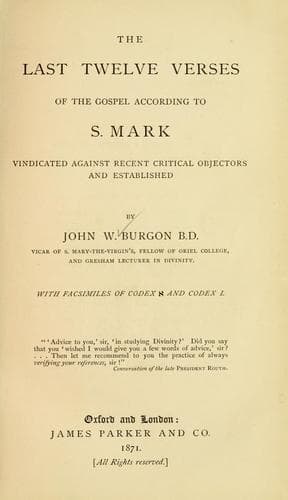
The Last Twelve Verses of the Gospel According to S. MarkBurgon, John William
Religion
The Last Twelve Verses of the Gospel According to S. Mark
Burgon, John William
Bible. Mark XVI, 9-20 -- Criticism, Textual
1. So then, the last Twelve Verses of S. Mark’s Gospel were anciently
often observed to be missing from the copies. Eusebius expressly says so.
I observe that he nowhere says that _their genuineness_ was anciently
_suspected_. As for himself, his elaborate discussion of their contents
convinces me that individually, he regarded them with favour. The mere
fact,—(it is best to keep to his actual statement,)—that “the entire
passage”(393) was “not met with in all the copies,” is the sum of his
evidence: and two Greek manuscripts, yet extant, supposed to be of the
ivth century (Codd. B and א), mutilated in this precise way, testify to
the truth of his statement.
2. But then it is found that these self-same Twelve Verses,—neither more
nor less,—anciently constituted _an integral __ Ecclesiastical Lection_;
which lection,—inasmuch as it is found to have established itself in every
part of Christendom at the earliest period to which liturgical evidence
reaches back, and to have been assigned from the very first to two of the
chiefest Church Festivals,—must needs be a lection of almost Apostolic
antiquity. Eusebius, I observe, (see p. 45), designates the portion of
Scripture in dispute by its technical name,—κεφάλαιον or περικοπή; (for so
an Ecclesiastical lection was anciently called). Here then is a rare
coincidence indeed. It is in fact simply unique. Surely, I may add that it
is in the highest degree suggestive also. It inevitably provokes the
inquiry,—Must not these two facts be not only connected, but even
_interdependent_? Will not the omission of the Twelve concluding Verses of
S. Mark from certain ancient copies of his Gospel, have been in some way
_occasioned by the fact_ that those same twelve verses constituted an
integral Church Lection? How is it possible to avoid suspecting that the
phenomenon to which Eusebius invites attention, (viz. that certain copies
of S. Mark’s Gospel in very ancient times had been mutilated from the end
of the 8th verse onwards,) ought to be capable of illustration,—will have
in fact _to be explained_, and in a word _accounted for_,—by the
circumstance that at the 8th verse of S. Mark’s xvith chapter, one ancient
Lection _came to an end_, and another ancient Lection _began_?
Public-domain text, read in full here on John Shaqi.
Reviews
Reviews
No reviews yet
Be the first to share your thoughts on this work.
Elsewhere in the archive
Join the Discussion
Join the discussion
Sign in to leave a comment or review.
Sign InorCreate an account