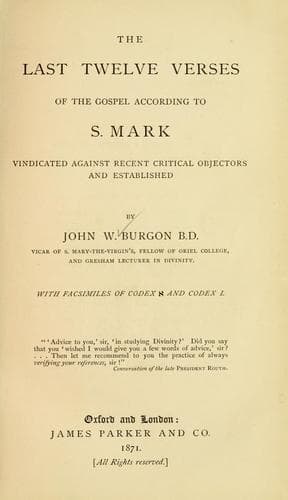
The Last Twelve Verses of the Gospel According to S. MarkBurgon, John William
Religion
The Last Twelve Verses of the Gospel According to S. Mark
Burgon, John William
Bible. Mark XVI, 9-20 -- Criticism, Textual
Somewhat thus, (I venture to think,) must every unprejudiced Reader of
intelligence hold parley with himself on reaching the close of the
preceding chapter. I need hardly add that I am thoroughly convinced he
would be reasoning rightly. I am going to shew that the Lectionary
practice of the ancient Church does indeed furnish a sufficient clue for
the unravelment of this now famous problem: in other words, enables us
satisfactorily to account for the omission of these Twelve Verses from
ancient copies of the collected Gospels. But I mean to do more. I propose
to make my appeal to documents which shall be observed to bear no
faltering witness in my favour. More yet. I propose that Eusebius himself,
the chief author of all this trouble, shall be brought back into Court and
invited to resyllable his Evidence; and I am much mistaken if even _he_
will not be observed to let fall a hint that we have at last got on the
right scent;—have accurately divined how this mistake took its first
beginning;—and, (what is not least to the purpose,) have correctly
apprehended what was his own real meaning in what he himself has said.
The proposed solution of the difficulty,—if not the evidence on which it
immediately rests,—might no doubt be exhibited within exceedingly narrow
limits. Set down abruptly, however, its weight and value would inevitably
fail to be recognised, even by those who already enjoy some familiarity
with these studies. Very few of the considerations which I shall have to
rehearse are in fact unknown to Critics: yet is it evident that their
bearing on the problem before us has hitherto altogether escaped their
notice. On the other hand, by one entirely a novice to this department of
sacred Science, I could scarcely hope to be so much as understood. Let me
be allowed, therefore, to preface what I have to say with a few
explanatory details which I promise shall not be tedious, and which I
trust will not be found altogether without interest either. If they are
anywhere else to be met with, it is my misfortune, not my fault, that I
have been hitherto unsuccessful in discovering the place.
I. From the earliest ages of the Church, (as I shewed at page 192-5,) it
has been customary to read certain definite portions of Holy Scripture,
determined by Ecclesiastical authority, publicly before the Congregation.
In process of time, as was natural, the sections so required for public
use were collected into separate volumes: Lections from the Gospels being
written out in a Book which was called “_Evangelistarium_,”
(εὐαγγελιστάριον,)—from the Acts and Epistles, in a book called
“_Praxapostolus_,” (πραξαπόστολος). These Lectionary-books, both Greek and
Syriac, are yet extant in great numbers,(394) and (I may remark in
passing) deserve a far greater amount of attention than has hitherto been
bestowed upon them.(395)
Public-domain text, read in full here on John Shaqi.
Reviews
Reviews
No reviews yet
Be the first to share your thoughts on this work.
Elsewhere in the archive
Join the Discussion
Join the discussion
Sign in to leave a comment or review.
Sign InorCreate an account