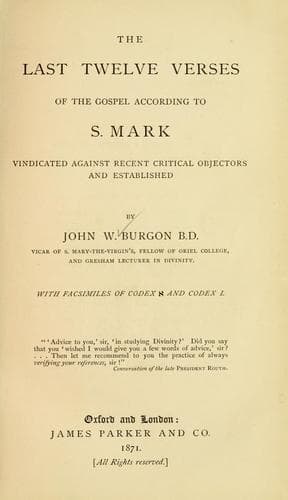
The Last Twelve Verses of the Gospel According to S. MarkBurgon, John William
Religion
The Last Twelve Verses of the Gospel According to S. Mark
Burgon, John William
Bible. Mark XVI, 9-20 -- Criticism, Textual
_When_ the Lectionary first took the form of a separate book, has not been
ascertained. That no copy is known to exist (whether in Greek or in
Syriac) older than the viiith century, proves nothing. Codices in daily
use, (like the Bibles used in our Churches,) must of necessity have been
of exceptionally brief duration; and Lectionaries, more even than Biblical
MSS. were liable to injury and decay.
II. But it is to be observed,—(and to explain this, is much more to my
present purpose,)—that besides transcribing the Ecclesiastical lections
into separate books, it became the practice at a very early period _to
adapt copies of the Gospel to lectionary purposes_. I suspect that this
practice began in the Churches of Syria; for Syriac copies of the Gospels
(_at least_ of the viith century) abound, which have the Lections more or
less systematically rubricated in the Text.(396) There is in the British
Museum a copy of S. Mark’s Gospel according to the Peshito version,
_certainly written previous to _A.D. 583, which has at least five or six
rubrics so inserted by the original scribe.(397) As a rule, in all later
cursive Greek MSS., (I mean those of the xiith to the xvth century,) the
Ecclesiastical lections are indicated throughout: while either at the
summit, or else at the foot of the page, the formula with which the
Lection was to be introduced is elaborately inserted; prefaced probably by
a rubricated statement (not always very easy to decipher) of the occasion
_when_ the ensuing portion of Scripture was to be read. The ancients, to a
far greater extent than ourselves,(398) were accustomed,—(in fact, they
made it _a rule_,)—to prefix unauthorized formulæ to their public
Lections; and these are sometimes found to have established themselves so
firmly, that at last they became as it were ineradicable; and later
copyists of the fourfold Gospel are observed to introduce them
unsuspiciously into the inspired text.(399) All that belongs to this
subject deserves particular attention; because it is _this_ which explains
not a few of the perturbations (so to express oneself) which the text of
the New Testament has experienced. We are made to understand how, what was
originally intended only as a _liturgical note_, became mistaken, through
the inadvertence or the stupidity of copyists, for a _critical
suggestion_; and thus, besides transpositions without number, there has
arisen, at one time, the insertion of something unauthorized into the text
of Scripture,—at another, the omission of certain inspired words, to the
manifest detriment of the sacred deposit. For although the _systematic_
rubrication of the Gospels for liturgical purposes is a comparatively
recent invention,—(I question if it be older in Greek MSS. than the xth
century,)—yet will persons engaged in the public Services of GOD’S House
have been prone, from the very earliest age, to insert memoranda of the
kind referred to, into the margin of their copies. In this way, in fact,
Public-domain text, read in full here on John Shaqi.
Reviews
Reviews
No reviews yet
Be the first to share your thoughts on this work.
Elsewhere in the archive
Join the Discussion
Join the discussion
Sign in to leave a comment or review.
Sign InorCreate an account