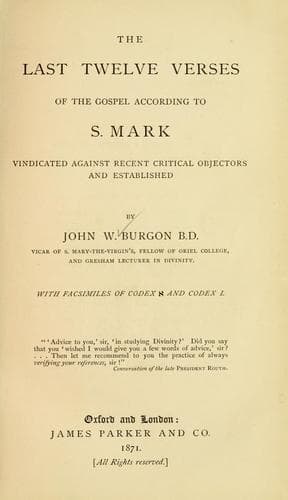
The Last Twelve Verses of the Gospel According to S. MarkBurgon, John William
Religion
The Last Twelve Verses of the Gospel According to S. Mark
Burgon, John William
Bible. Mark XVI, 9-20 -- Criticism, Textual
it may be regarded as certain that in countless minute particulars the
text of Scripture has been depraved. Let me not fail to add, that by a
judicious, and above all by an _unprejudiced_ use of the materials at our
disposal, it may, even at this distance of time, in every such particular,
be successfully restored.(400)
III. I now proceed to shew, by an induction of instances, that _even in
the oldest copies in existence_, I mean in Codd. B, א, A, C, and D, the
Lectionary system of the early Church has left abiding traces of its
operation. When a few such undeniable cases have been adduced, all
objections grounded on _primâ facie_ improbability will have been
satisfactorily disposed of. The activity, as well as the existence of such
a disturbing force and depraving influence, _at least_ as far back as the
beginning of the ivth century, (but it is in fact more ancient by full two
hundred years,) will have been established: of which I shall only have to
shew, in conclusion, that the omission of “the last Twelve Verses” of S.
Mark’s Gospel is probably but one more instance,—though confessedly by far
the most extraordinary of any.
(1.) From Codex B then, as well as from Cod. A, the two grand verses which
describe our LORD’S “Agony and Bloody Sweat,” (S. Luke xxii. 43, 44,) are
missing. The same two verses are absent also from a few other important
MSS., as well as from both the Egyptian versions; but I desire to fasten
attention on the confessedly erring testimony in this place of Codex B.
“Confessedly erring,” I say; for the genuineness of those two verses is no
longer disputed. Now, in every known Evangelistarium, the two verses here
omitted by Cod. B follow, (the Church so willed it,) S. Matth. xxvi. 39,
and are read as a regular part of the lesson for the Thursday in Holy
Week.(401) Of course they are also _omitted_ in the same Evangelistaria
from the lesson for the Tuesday after Sexagesima, (τῇ γ᾽ τῆς τυροφάγου, as
the Easterns call that day,) when S. Luke xxii. 39-xxiii. 1 used to be
read. Moreover, in all ancient copies of the Gospels which have been
accommodated to ecclesiastical use, _the reader of S. Luke xxii. is
invariably directed by a marginal note to leave out those two verses_, and
to proceed per saltum from ver. 42 to ver. 45.(402) What more obvious
therefore than that the removal of the paragraph from its proper place in
S. Luke’s Gospel is to be attributed to nothing else but the Lectionary
practice of the primitive Church? Quite unreasonable is it to impute
heretical motives, or to invent any other unsupported theory, while this
plain solution of the difficulty is at hand.
Public-domain text, read in full here on John Shaqi.
Reviews
Reviews
No reviews yet
Be the first to share your thoughts on this work.
Elsewhere in the archive
Join the Discussion
Join the discussion
Sign in to leave a comment or review.
Sign InorCreate an account