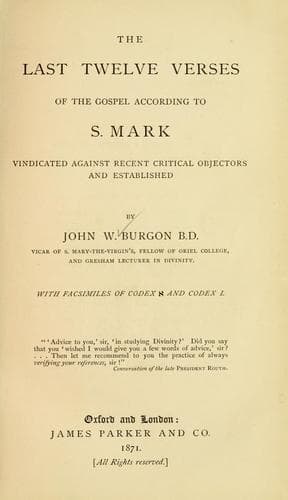
The Last Twelve Verses of the Gospel According to S. MarkBurgon, John William
Religion
The Last Twelve Verses of the Gospel According to S. Mark
Burgon, John William
Bible. Mark XVI, 9-20 -- Criticism, Textual
(2.) The same Cod. B., (with which Codd. א, C, L, U and Γ are observed
here to conspire,) introduces the piercing of the SAVIOUR’S side (S. John
xix. 34) at the end of S. Matth. xxvii. 49. Now, I only do not insist that
this must needs be the result of the singular Lectionary practice already
described at p. 202, because a scholion in Cod. 72 records the singular
fact that in the Diatessaron of Tatian, after S. Matth. xxvii. 48, was
read ἄλλος δὲ λαβὼν λόγχην ἔνυξεν αὐτοῦ τὴν πλευρὰν: καὶ ἐξῆλθεν ὕδωρ καὶ
αἷμα. (Chrysostom’s codex was evidently vitiated in _precisely_ the same
way.) This interpolation therefore may have resulted from the corrupting
influence of Tatian’s (so-called) “Harmony.” See Appendix (H).
(3.) To keep on safe ground. Codd. B and D concur in what Alford justly
calls the “grave error” of simply omitting from S. Luke xxiii. 34, our
LORD’S supplication on behalf of His murderers, (ὁ δὲ Ἰησοῦς ἔλεγε, Πάτερ,
ἄφες αὐτοῖς: οὐ γὰρ οἴδασι τί ποιοῦσι). They are not quite singular in so
doing; being, as usual, kept in countenance by certain copies of the old
Latin, as well as by both the Egyptian versions. How is this “grave error”
in so many ancient MSS. to be accounted for? (for a “grave error” or
rather “a fatal omission” it certainly is). Simply by the fact that in the
Eastern Church the Lection for the Thursday after Sexagesima _breaks off
abruptly, immediately before these very words_,—to recommence at ver.
44.(403)
(4.) Note, that at ver. 32, _the eighth _“Gospel of the Passion”_
begins_,—which is the reason why Codd. B and א (with the Egyptian
versions) exhibit a singular irregularity in that place; and why the
Jerusalem Syriac introduces the established formula of the Lectionaries
(σὺν τῷ Ἰησοῦ) at the same juncture.
(If I do not here insist that the absence of the famous _pericopa de
adulterâ_ (S. John vii. 53-viii. 11,) from so many MSS., is to be
explained in precisely the same way, it is only because the genuineness of
that portion of the Gospel is generally denied; and I propose, in this
enumeration of instances, not to set foot on disputed ground. I am
convinced, nevertheless, that the first occasion of the omission of those
memorable verses was the lectionary practice of the primitive Church,
which, on Whitsunday, read from S. John vii. 37 to viii. 12, _leaving out
the twelve verses_ in question. Those verses, from the nature of their
contents, (as Augustine declares,) easily came to be viewed with dislike
or suspicion. The passage, however, is as old as the second century, for
it is found in certain copies of the old Latin. Moreover Jerome
deliberately gave it a place in the Vulgate. I pass on.)
Public-domain text, read in full here on John Shaqi.
Reviews
Reviews
No reviews yet
Be the first to share your thoughts on this work.
Elsewhere in the archive
Join the Discussion
Join the discussion
Sign in to leave a comment or review.
Sign InorCreate an account