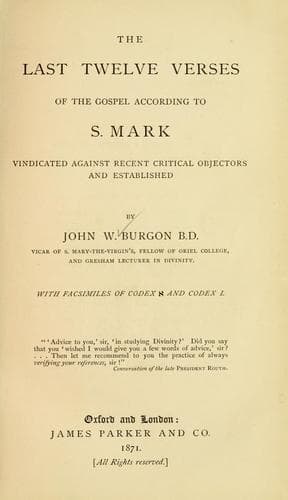
The Last Twelve Verses of the Gospel According to S. MarkBurgon, John William
Religion
The Last Twelve Verses of the Gospel According to S. Mark
Burgon, John William
Bible. Mark XVI, 9-20 -- Criticism, Textual
VI. And yet, although the practice of thus indicating the beginning and
the end of a liturgical section, does not seem to have come into general
use until about the xiith century; and although, previous to the ixth
century, systematic liturgical directions are probably unknown;(417) the
_need_ of them must have been experienced by one standing up to read
before the congregation, long before. The want of some reminder where he
was to begin,—above all, of some hint where he was to leave off,—will have
infallibly made itself felt from the first. Accordingly, there are not
wanting indications that, occasionally, ΤΕΛΟΣ (or ΤΟ ΤΕΛΟΣ) was written in
the margin of Copies of the Gospels at an exceedingly remote epoch. One
memorable example of this practice is supplied by the Codex Bezæ (D):
where in S. Mark xiv. 41, instead of ἀπέχει ἦλθεν ἡ ὤρα,—we meet with the
unintelligible ΑΠΕΧΕΙ ΤΟ ΤΕΛΟΣ ΚΑΙ Η ΩΡΑ. Now, nothing else has here
happened but that a marginal note, designed originally to indicate the end
(ΤΟ ΤΕΛΟΣ) of the lesson for the third day of the iind week of the
Carnival, has lost its way from the end of ver. 42, and got thrust into
the text of ver. 41,—to the manifest destruction of the sense.(418) I find
D’s error here is shared (_a_) by the Peshito Syriac, (_b_) by the old
Latin, and (_c_) by the Philoxenian: venerable partners in error, truly!
for the first two probably carry back this false reading to _the second
century of our æra_; and so, furnish one more remarkable proof, to be
added to the fifteen (or rather the forty) already enumerated (pp.
217-23), that the lessons of the Eastern Church were settled at a period
long anterior to the date of the oldest MS. of the Gospels extant.
VII. Returning then to the problem before us, I venture to suggest as
follows:—What if, at a very remote period, this same isolated liturgical
note (ΤΟ ΤΕΛΟΣ) occurring at S. Mark xvi. 8, (which _is_ “the end” of _the
Church-lection_ for the iind Sunday after Easter,) should have unhappily
suggested to some copyist,—καλλιγραφίας _quam vel Criticæ Sacræ vel rerum
Liturgicarum peritior_,—the notion that the entire “_Gospel according to
S. Mark_,” came to an end at verse 8?... I see no more probable account of
the matter, I say, than this:—That the mutilation of the last chapter of
S. Mark has resulted from the fact, that some very ancient scribe
_misapprehended the import of the solitary liturgical note_ ΤΕΛΟΣ (or ΤΟ
ΤΕΛΟΣ) which he found at the close of verse 8. True, that he will have
probably beheld, further on, several additional στίχοι. But if he did, how
could he acknowledge the fact more loyally than by leaving (as the author
of Cod. B is observed to have done) one entire column blank, before
proceeding with S. Luke? He hesitated, all the same, _to transcribe_ any
further, having before him, (as he thought,) an assurance that “THE END”
had been reached at ver. 8.
Public-domain text, read in full here on John Shaqi.
Reviews
Reviews
No reviews yet
Be the first to share your thoughts on this work.
Elsewhere in the archive
Join the Discussion
Join the discussion
Sign in to leave a comment or review.
Sign InorCreate an account