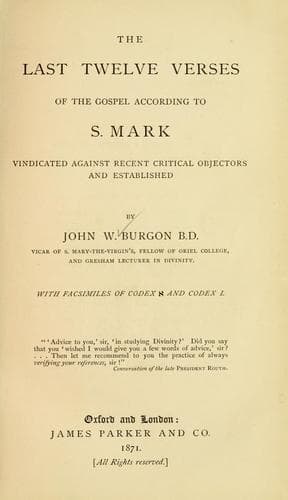
The Last Twelve Verses of the Gospel According to S. MarkBurgon, John William
Religion
The Last Twelve Verses of the Gospel According to S. Mark
Burgon, John William
Bible. Mark XVI, 9-20 -- Criticism, Textual
VIII. That some were found in very early times eagerly to acquiesce in
this omission: to sanction it: even to multiply copies of the Gospel so
mutilated; (critics or commentators intent on nothing so much as
reconciling the apparent discrepancies in the Evangelical
narratives:)—appears to me not at all unlikely.(419) Eusebius almost says
as much, when he puts into the mouth of one who is for getting rid of
these verses altogether, the remark that “they would be in a manner
superfluous _if it should appear that their testimony is at variance with
that of the other Evangelists_.”(420) (The ancients were giants in
Divinity but children in Criticism.) On the other hand, I altogether agree
with Dean Alford in thinking it highly improbable that the difficulty of
harmonizing one Gospel with another in this place, (such as it is,) was
the cause why these Twelve Verses were originally suppressed.(421) (1)
First, because there really was no need to withhold more than three,—at
the utmost, five of them,—if _this_ had been the reason of the omission.
(2) Next, because it would have been easier far to introduce some critical
correction of any supposed discrepancy, than to sweep away the whole of
the unoffending context. (3) Lastly, because nothing clearly was gained by
causing the Gospel to end so abruptly that every one must see at a glance
that it had been mutilated. No. The omission having originated in a
mistake, was perpetuated for a brief period (let us suppose) only through
infirmity of judgment: or, (as I prefer to believe), only in consequence
of the religious fidelity of copyists, who were evidently always
instructed to transcribe exactly what they found in the copy set before
them. The Church meanwhile in her corporate capacity, has never known
anything at all of the matter,—as was fully shewn above in Chap. X.
IX. When this solution of the problem first occurred to me, (and it
occurred to me long before I was aware of the memorable reading ΤΟ ΤΕΛΟΣ
in the Codex Bezæ, already adverted to,) I reasoned with myself as
follows:—But if the mutilation of the second Gospel came about in this
particular way, the MSS. are bound to remember _something_ of the
circumstance; and in ancient MSS., if I am right, I ought certainly to
meet with _some_ confirmation of my opinion. According to my view, at the
root of this whole matter lies the fact that at S. Mark xvi. 8 a
well-known Ecclesiastical lesson comes to an end. Is there not perhaps
something exceptional in the way that the close of that liturgical section
was anciently signified?
X. In order to ascertain this, I proceeded to inspect every copy of the
Gospels in the Imperial Library at Paris;(422) and devoted seventy hours
exactly, with unflagging delight, to the task. The success of the
experiment astonished me.
Public-domain text, read in full here on John Shaqi.
Reviews
Reviews
No reviews yet
Be the first to share your thoughts on this work.
Elsewhere in the archive
Join the Discussion
Join the discussion
Sign in to leave a comment or review.
Sign InorCreate an account