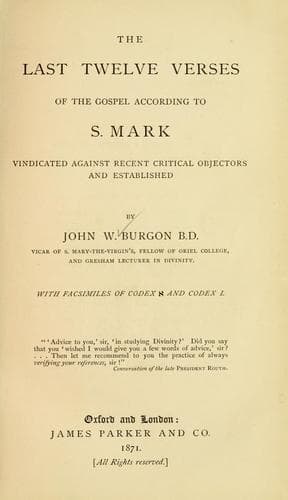
The Last Twelve Verses of the Gospel According to S. MarkBurgon, John William
Religion
The Last Twelve Verses of the Gospel According to S. Mark
Burgon, John William
Bible. Mark XVI, 9-20 -- Criticism, Textual
1. I began with _our_ Cod. 24 ( = Reg. 178) of the Gospels: turned to the
last page of S. Mark: and beheld, in a Codex of the xith Century wholly
devoid of the Lectionary apparatus which is sometimes found in MSS. of a
similar date,(423) at fol. 104, the word + ΤΕΛΟΣ + conspicuously written
by the original scribe immediately after S. Mark xvi. 8, as well as at the
close of the Gospel. _It occurred besides only at ch._ ix. 9, (the end of
the lesson for the Transfiguration.) And yet there are _at least seventy_
occasions in the course of S. Mark’s Gospel where, in MSS. which have been
accommodated to Church use, it is usual to indicate the close of a
Lection. This discovery, which surprised me not a little, convinced me
that I was on the right scent; and every hour I met with some fresh
confirmation of the fact.
2. For the intelligent reader will readily understand that three such
deliberate liturgical memoranda, occurring solitary in a MS. of this date,
are to be accounted for only in one way. They infallibly represent a
corresponding peculiarity in some far more ancient document. The fact that
the word ΤΕΛΟΣ is here (_a_) set down unabbreviated, (_b_) in black ink,
and (_c_) as part of the text,—points unmistakably in the same direction.
But that Cod. 24 is derived from a Codex of much older date is rendered
certain by a circumstance which shall be specified at foot.(424)
3. The very same phenomena reappear in Cod. 36.(425) The sign + ΤΕΛΟΣ +,
(which occurs punctually at S. Mark xvi. 8 and again at v. 20,) is found
besides in S. Mark’s Gospel only at chap. i. 8;(426) at chap. xiv. 31; and
(+ ΤΕΛΟΣ ΤΟΥ ΚΕΦΑΛ) at chap. xv. 24;—being on every occasion incorporated
with the Text. Now, when it is perceived that in the second and third of
these places, ΤΕΛΟΣ has clearly lost its way,—appearing where _no_
Ecclesiastical lection came to an end,—it will be felt that the MS. before
us (of the xith century) if it was not actually transcribed from,—must at
least exhibit at second hand,—a far more ancient Codex.(427)
4. Only once more.—Codex 22 ( = Reg. 72) was never prepared for Church
purposes. A rough hand has indeed scrawled indications of the beginnings
and endings of a few of the Lessons, here and there; but these liturgical
notes are no part of the original MS. At S. Mark xvi. 8, however, we are
presented (as before) with the solitary note + ΤΕΛΟΣ +—, incorporated with
the text. Immediately after which, (in writing of the same size,) comes a
memorable statement(428) in red letters. The whole stands thus:—
ΦΟΒΟΥΝΤΟ ΓΑΡ + ΤΕΛΟΣ +—
[cross] ΕΝ ΤΙΣΙ ΤΩΝ ΑΝΤΙΓΡΑΦΩΝ.
ΕΩΣ ΩΔΕ ΠΛΗΡΟΥΤΑΙ Ο ΕΥ
ΑΓΓΕΛΙΣΤΗΣ: ΕΝ ΠΟΛΛΟΙΣ
ΔΕ. ΚΑΙ ΤΑΥΤΑ ΦΕΡΕΤΑΙ +—
ΑΝΑΣΤΑΣ ΔΕ. ΠΡΟΙ ΠΡΩΤΗ ΣΑΒΒΑΤΩΝ.
Public-domain text, read in full here on John Shaqi.
Reviews
Reviews
No reviews yet
Be the first to share your thoughts on this work.
Elsewhere in the archive
Join the Discussion
Join the discussion
Sign in to leave a comment or review.
Sign InorCreate an account