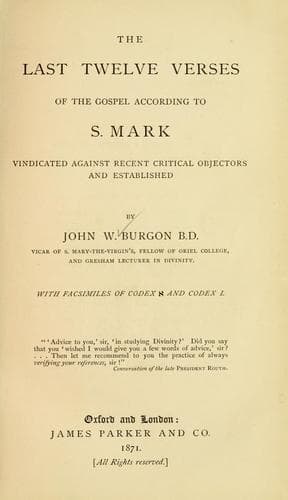
The Last Twelve Verses of the Gospel According to S. MarkBurgon, John William
Religion
The Last Twelve Verses of the Gospel According to S. Mark
Burgon, John William
Bible. Mark XVI, 9-20 -- Criticism, Textual
And then follows the rest of the Gospel; at the end of which, the sign +
ΤΕΛΟΣ + is again repeated,—which sign, however, occurs _nowhere else_ in
the MS. _nor at the end of any of the other three Gospels_. A more
opportune piece of evidence could hardly have been invented. A statement
so apt and so significant was surely a thing rather to be wished than to
be hoped for. For here is the liturgical sign ΤΕΛΟΣ not only occurring in
the wholly exceptional way of which we have already seen examples, but
actually followed by the admission that “In certain copies, _the
Evangelist proceeds no further_.” The two circumstances so brought
together seem exactly to bridge over the chasm between Codd. B and א on
the one hand,—and Codd. 24 and 36 on the other; and to supply us with
precisely the link of evidence which we require. For observe:—During the
first six centuries of our æra, no single instance is known of a codex in
which ΤΕΛΟΣ is written at the end of a Gospel. The subscription of S. Mark
for instance is _invariably_ either ΚΑΤΑ ΜΑΡΚΟΝ,—(as in B and א): or else
ΕΥΑΓΓΕΛΙΟΝ ΚΑΤΑ ΜΑΡΚΟΝ,—(as in A and C, and the other older uncials):
_never_ ΤΕΛΟΣ. But here is a Scribe who first copies the _liturgical_ note
ΤΕΛΟΣ,—and then volunteers the _critical_ observation that “in some copies
of S. Mark’s Gospel the Evangelist proceeds no further!” A more
extraordinary corroboration of the view which I am endeavouring to
recommend to the reader’s acceptance, I really cannot imagine. Why, the
ancient Copyist actually comes back, in order to assure me that the
suggestion which I have been already offering in explanation of the
difficulty, is the true one!
5. I am not about to abuse the reader’s patience with a prolonged
enumeration of the many additional conspiring circumstances,—insignificant
in themselves and confessedly unimportant when considered singly, but of
which the cumulative force is unquestionably great,—which an examination
of 99 MSS. of the Gospels brought to light.(429) Enough has been said
already to shew,
(1st.) That it must have been a customary thing, at a very remote age, to
write the word ΤΕΛΟΣ against S. Mark xvi. 8, even when the same note was
withheld from the close of almost every other ecclesiastical lection in
the Gospel.
(2ndly.) That this word, or rather note, which no doubt was originally
written as a liturgical memorandum in the margin, became at a very early
period incorporated with the text; where, retaining neither its use nor
its significancy, it was liable to misconception, and may have easily come
to be fatally misunderstood.
And although these two facts certainly prove nothing in and by themselves,
yet, when brought close alongside of the problem which has to be solved,
their significancy becomes immediately apparent: for,
Public-domain text, read in full here on John Shaqi.
Reviews
Reviews
No reviews yet
Be the first to share your thoughts on this work.
Elsewhere in the archive
Join the Discussion
Join the discussion
Sign in to leave a comment or review.
Sign InorCreate an account