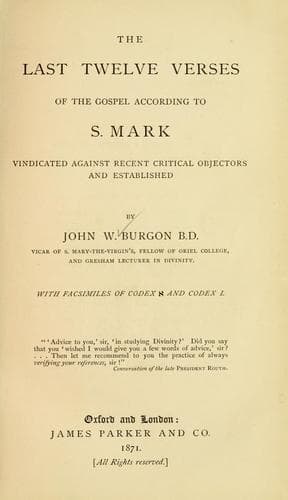
The Last Twelve Verses of the Gospel According to S. MarkBurgon, John William
Religion
The Last Twelve Verses of the Gospel According to S. Mark
Burgon, John William
Bible. Mark XVI, 9-20 -- Criticism, Textual
(3rdly.) As a matter of fact, there are found to have existed before the
time of Eusebius, copies of S. Mark’s Gospel which _did_ come to an end at
this very place. Now, that _the Evangelist_ left off there, no one can
believe.(430) _Why_, then, did _the Scribe_ leave off? But the Reader is
already in possession of the reason why. A sufficient explanation of the
difficulty has been elicited from the very MSS. themselves. And surely
when, suspended to an old chest which has been locked up for ages, a key
is still hanging which fits the lock exactly and enables men to open the
chest with ease, they are at liberty to assume that the key _belongs_ to
the lock; is, in fact, the only instrument by which the chest may lawfully
be opened.
XI. And now, in conclusion, I propose that we summon back our original
Witness, and invite him to syllable his evidence afresh, in order that we
may ascertain if perchance it affords any countenance whatever to the view
which I have been advocating. Possible at least it is that in the
Patristic record that copies of S. Mark’s Gospel were anciently defective
from the 8th verse onwards _some_ vestige may be discoverable of the
forgotten truth. Now, it has been already fully shewn that it is a mistake
to introduce into this discussion any other name but that of
Eusebius.(431) Do, then, the terms in which _Eusebius_ alludes to this
matter lend us any assistance? Let us have the original indictment read
over to us once more: and _this_ time we are bound to listen to every word
of it with the utmost possible attention.
1. A problem is proposed for solution. “There are two ways of solving it,”
(Eusebius begins):—ὁ μὲν γὰρ [τὸ κεφάλαιον αὐτὸ] τὴν τοῦτο φάσκουσαν
περικοπὴν ἀθετῶν, εἔποι ἀν μὴ ἐν ἅπασιν αὐτην φέρεσθαι τοῖς ἀντιγράφοις
τοῦ κατὰ Μάρκον εὐαγγελίου: τὰ γοῦν ἀκριβῆ τῶν ἀντιγράφων ΤΟ ΤΕΛΟΣ
περιγράφει τῆς κατὰ τὸν Μάρκον ἱστορίας ἐν τοῖς λόγοις κ.τ.λ. οἶς
ἐπιλέγει, “καὶ οὐδενὶ οὐδὲν εἶπον, ἐφοβοῦντο γάρ.” Ἐν τούτῳ σχεδὸν ἐν
ἅπασι τοῖς ἀντιγράφοις τοῦ κατά Μάρκον εὐαγγελίου περιγέγραπται ΤΟ
ΤΕΛΟΣ(432) ... Let us halt here for one moment.
Public-domain text, read in full here on John Shaqi.
Reviews
Reviews
No reviews yet
Be the first to share your thoughts on this work.
Elsewhere in the archive
Join the Discussion
Join the discussion
Sign in to leave a comment or review.
Sign InorCreate an account