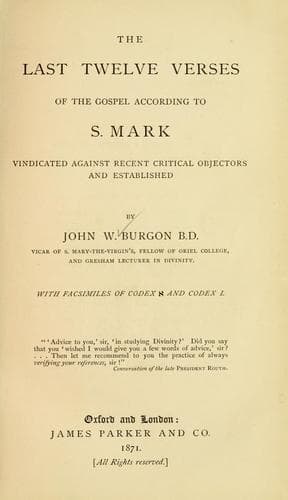
The Last Twelve Verses of the Gospel According to S. MarkBurgon, John William
Religion
The Last Twelve Verses of the Gospel According to S. Mark
Burgon, John William
Bible. Mark XVI, 9-20 -- Criticism, Textual
fragment,” and reproduces all the arguments, external and internal, which
have ever been arrayed against it, without a particle of misgiving. The
“note” with which he takes leave of the subject is even insolent.(22) A
comparison (he says) of these “fragments” (ver. 9-18 and 19) with the
parallel places in the other Gospels and in the Acts, shews how
vacillating and various were the Apostolical traditions concerning the
appearances of our LORD after His Resurrection, and concerning His
Ascension. (“Hast thou killed, and also taken possession?”)
Such, then, is the hostile verdict concerning these last twelve verses
which I venture to dispute, and which I trust I shall live to see
reversed. The writers above cited will be found to rely (1.) on the
external evidence of certain ancient MSS.; and (2.) on Scholia which state
“that the more ancient and accurate copies terminated the Gospel at ver.
8.” (3.) They assure us that this is confirmed by a formidable array of
Patristic authorities. (4.) Internal proof is declared not to be wanting.
Certain incoherences and inaccuracies are pointed out. In fine, “the
phraseology and style of the section” are declared to be “unfavourable to
its authenticity;” not a few of the words and expressions being “foreign
to the diction of Mark.”—I propose to shew that all these confident and
imposing statements are to a great extent either mistakes or
exaggerations, and that the slender residuum of fact is about as powerless
to achieve the purpose of the critics as were the seven green withs of the
Philistines to bind Samson.
In order to exhibit successfully what I have to offer on this subject, I
find it necessary to begin (in the next chapter) at the very beginning. I
think it right, however, in this place to premise a few plain
considerations which will be of use to us throughout all our subsequent
inquiry; and which indeed we shall never be able to afford to lose sight
of for long.
Public-domain text, read in full here on John Shaqi.
Reviews
Reviews
No reviews yet
Be the first to share your thoughts on this work.
Join the Discussion
Join the discussion
Sign in to leave a comment or review.
Sign InorCreate an account