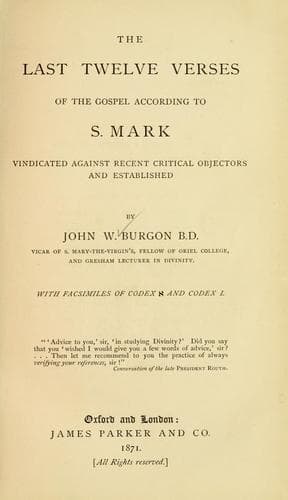
The Last Twelve Verses of the Gospel According to S. MarkBurgon, John William
Religion
The Last Twelve Verses of the Gospel According to S. Mark
Burgon, John William
Bible. Mark XVI, 9-20 -- Criticism, Textual
The question at issue being simply this,—Whether it is reasonable to
suspect that the last twelve verses of S. Mark are a spurious accretion
and unauthorized supplement to his Gospel, or not?—the whole of our
business clearly resolves itself into an examination of what has been
urged in proof that the former alternative is the correct one. Our
opponents maintain that these verses did not form part of the original
autograph of the Evangelist. But it is a known rule in the Law of Evidence
that _the burthen of proof lies on the party who asserts the affirmative
of the issue_.(23) We have therefore to ascertain in the present instance
what the supposed proof is exactly worth; remembering always that in this
subject-matter a _high degree of probability_ is the only kind of proof
which is attainable. When, for example, it is contended that the famous
words in S. John’s first Epistle (1 S. John v. 7, 8,) are not to be
regarded as genuine, the fact that they are away from almost every known
Codex is accepted as a proof that they were also away from the autograph
of the Evangelist. On far less weighty evidence, in fact, we are at all
times prepared to yield the hearty assent of our understanding in this
department of sacred science.
And yet, it will be found that evidence of overwhelming weight, if not of
an entirely different kind, is required in the present instance: as I
proceed to explain.
1. When it is contended that our LORD’s reply to the young ruler (S. Matt.
xix. 17) _was not_ Τί με λέγεις ἀγαθόν; οὐδεὶς ἀγαθὸς, εἰ μὴ εῖς, ὁ
Θεός,—it is at the same time insisted that _it was_ Τί με ἐρωτᾷς περὶ τοῦ
ἀγαθοῦ; εῖς ἐστὶν ὁ ἀγαθός. It is proposed to omit the former words _only_
because an alternative clause is at hand, which it is proposed to
substitute in its room.
2. Again. When it is claimed that some given passage of the Textus
Receptus,—S. Mark ch xv. 28, for example, (καὶ ἐπληρώθη ἡ γραφὴ ἡ λέγουσα,
Καὶ μετὰ ἀνόμων ἐλογίσθη,) or the Doxology in S. Matth. vi. 13,—is
spurious, all that is pretended is that certain words are an unauthorized
addition to the inspired text; and that by simply omitting them we are so
far restoring the Gospel to its original integrity.—The same is to be said
concerning _every other charge of interpolation which can be named_. If
the celebrated “pericopa de adulterâ,” for instance, be indeed not
genuine, we have but to leave out those twelve verses of S. John’s Gospel,
and to read chap. vii. 52 in close sequence with chap. viii. 12; and we
are assured that we are put in possession of the text as it came from the
hands of its inspired Author. Nor, (it must be admitted), is any
difficulty whatever occasioned thereby; for there is no reason assignable
why the two last-named verses should _not_ cohere; (there is no internal
improbability, I mean, in the supposition;) neither does there exist any
_à priori_ reason why a considerable portion of narrative should be looked
for in that particular part of the Gospel.
Public-domain text, read in full here on John Shaqi.
Reviews
Reviews
No reviews yet
Be the first to share your thoughts on this work.
Join the Discussion
Join the discussion
Sign in to leave a comment or review.
Sign InorCreate an account