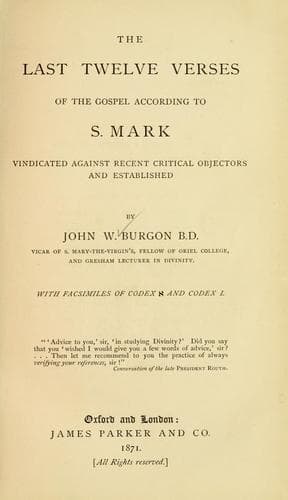
The Last Twelve Verses of the Gospel According to S. MarkBurgon, John William
Religion
The Last Twelve Verses of the Gospel According to S. Mark
Burgon, John William
Bible. Mark XVI, 9-20 -- Criticism, Textual
(1st.) It is plain from internal considerations that the improbability of
the hypothesis is excessive; “the contents of these Verses being such as
to preclude the supposition that they were the work of a post-Apostolic
period. The very difficulties which they present afford the strongest
presumption of their genuineness.” No fabricator of a supplement to S.
Mark’s Gospel would have ventured on introducing so many minute _seeming_
discrepancies: and certainly “his contemporaries would not have accepted
and transmitted such an addition,” if he had. It has also been shewn at
great length that the Internal Evidence for the genuineness of these
Verses is overwhelmingly strong.(477) But,
(2nd.) Even external Evidence is not wanting. It has been acutely pointed
out long since, that the absence of a vast assemblage of various Readings
in this place, is, in itself, a convincing argument that we have here to
do with no spurious appendage to the Gospel.(478) Were this a deservedly
suspected passage, it must have shared the fate of all other deservedly
(or undeservedly) suspected passages. It never could have come to pass
that the various Readings which these Twelve Verses exhibit would be
_considerably fewer_ than those which attach to the last twelve verses of
any of the other three Gospels.
(3rd.) And then surely, if the original Gospel of S. Mark had been such an
incomplete work as is feigned, the fact would have been notorious from the
first, and must needs have become the subject of general comment.(479) It
may be regarded as certain that so extraordinary a circumstance would have
been largely remarked upon by the Ancients, and that evidence of the fact
would have survived in a hundred quarters. It is, I repeat, simply
incredible that Tradition would have proved so utterly neglectful of her
office as to remain _quite_ silent on such a subject, if the facts had
been such as are imagined. Either Papias, or else John the
Presbyter,—Justin Martyr, or Hegesippus, or one of the “Seniores apud
Irenæum,”—Clemens Alexandrinus, or Tertullian, or Hippolytus,—if not
Origen, yet at least Eusebius,—if not Eusebius, yet certainly
Jerome,—_some_ early Writer, I say, must _certainly_ have recorded the
tradition that S. Mark’s Gospel, as it came from the hands of its inspired
author, was an incomplete or unfinished work. The silence of the Ancients,
joined to the inherent improbability of the conjecture,—(_that_ silence so
profound, _this_ improbability so gross!)—is enough, I submit, _in the
entire absence of Evidence on the other side_, to establish _the very
contradictory_ of the alternative which recent Critics are so strenuous in
recommending to our acceptance.
Public-domain text, read in full here on John Shaqi.
Reviews
Reviews
No reviews yet
Be the first to share your thoughts on this work.
Elsewhere in the archive
Join the Discussion
Join the discussion
Sign in to leave a comment or review.
Sign InorCreate an account