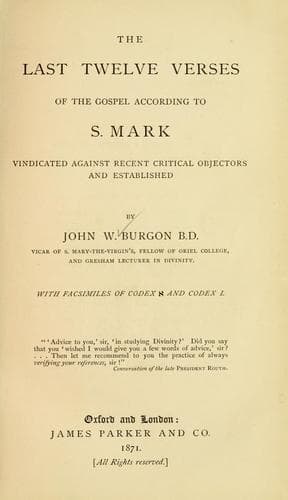
The Last Twelve Verses of the Gospel According to S. MarkBurgon, John William
Religion
The Last Twelve Verses of the Gospel According to S. Mark
Burgon, John William
Bible. Mark XVI, 9-20 -- Criticism, Textual
(4th.) But on the contrary. We have indirect yet convincing testimony that
the _oldest_ copies of all _did contain_ the Verses in question:(480)
while so far are any of the Writers just now enumerated from recording
that these verses were absent from the early copies, that five out of
those ten Fathers actually quote, or else refer to the verses in question
in a way which shews that in their day they were the recognised
termination of S. Mark’s Gospel.(481)
We consider ourselves at liberty, therefore, to turn our attention to the
rival alternative. Our astonishment is even excessive that it should have
been seriously expected of us that we could accept without Proof of any
sort,—without a particle of Evidence, external, internal, or even
traditional,—the extravagant hypothesis that S. Mark put forth an
unfinished Gospel; when the obvious and easy alternative solicits us, of
supposing,
II. That, at some period _subsequent_ to the time of the Evangelist,
certain copies of S. Mark’s Gospel suffered that mutilation in respect of
their last Twelve Verses of which we meet with _no trace whatever, no
record of any sort, until the beginning of the fourth century_.
(i.) And the facts which _now_ meet us on the very threshold, are in a
manner conclusive: for if Papias and Justin Martyr [A.D. 150] do not refer
to, yet certainly Irenæus [A.D. 185] and Hippolytus [A.D. 190-227]
_distinctly quote_ Six out of the Twelve suspected Verses,—which are also
met with in the two oldest Syriac Versions, as well as in the old Latin
Translation. Now the latest of these authorities is earlier by full a
hundred years than _the earliest record_ that the verses in question were
ever absent from ancient MSS. At the eighth Council of Carthage, (as
Cyprian relates,) [A.D. 256] Vincentius a Thiberi, one of the eighty-seven
African Bishops there assembled, quoted the 17th verse in the presence of
the Council.
(ii.) Nor is this all.(482) Besides the Gothic and Egyptian versions in
the ivth century; besides Ambrose, Cyril of Alexandria, Jerome, and
Augustine in the vth, to say nothing of Codices A and C;—the Lectionary of
the Church universal, _probably from the second century of our æra_, is
found to bestow its solemn and emphatic sanction on _every one_ of these
Twelve Verses. They are met with _in every MS. of the Gospels in
existence_, uncial and cursive,—_except two_;(483) they are found _in
every Version_; and are contained besides in _every known Lectionary_,
where they are appointed to be read at Easter and on Ascension Day.(484)
(iii.) Early in the ivth century, however, we are encountered by a famous
place in the writings of Eusebius [A.D. 300-340], who, (as I have
elsewhere explained,(485)) is the _only_ Father who delivers any
independent testimony on this subject at all. What he says has been
strangely misrepresented. It is simply as follows:—
Public-domain text, read in full here on John Shaqi.
Reviews
Reviews
No reviews yet
Be the first to share your thoughts on this work.
Elsewhere in the archive
Join the Discussion
Join the discussion
Sign in to leave a comment or review.
Sign InorCreate an account