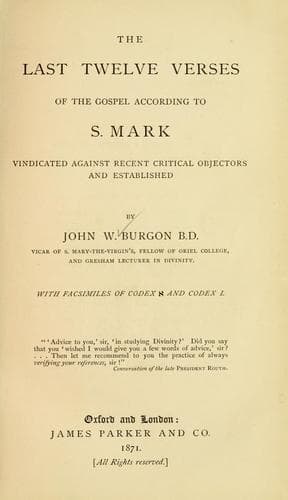
The Last Twelve Verses of the Gospel According to S. MarkBurgon, John William
Religion
The Last Twelve Verses of the Gospel According to S. Mark
Burgon, John William
Bible. Mark XVI, 9-20 -- Criticism, Textual
(_a_) One, “Marinus,” is introduced _quoting this part of S. Mark’s Gospel
without suspicion_, and enquiring, How its opening statement is to be
reconciled with S. Matth. xxviii. 1? Eusebius, in reply, points out that a
man whose only object was to get rid of the difficulty, might adopt the
expedient of saying that this last section of S. Mark’s Gospel “is _not
found in all the copies_:” (μὴ ἐν ἁπᾶσι φέρεσθαι.) Declining, however, to
act thus presumptuously in respect of anything claiming to be a part of
Evangelical Scripture, (οὐδ᾽ ὁτιοῦν τολμῶν ἀθετεῖν τῶν ὁπωσοῦν ἐν τῇ τῶν
εὐαγγελίων γραφῇ φερομένων,)—_he adopts the hypothesis that the text is
genuine_. Καὶ δὴ τοῦδε τοῦ μέρους συγχωρουμένου εἶναι ἀληθοῦς, he begins:
and he enters at once without hesitation on an elaborate discussion to
shew _how the two places may be reconciled_.(486) What there is in this to
countenance the notion that in the opinion of Eusebius “the Gospel
according to S. Mark originally terminated at the 8th verse of the last
chapter,”—I profess myself unable to discover. I draw from his words the
precisely opposite inference. It is not even clear to me that the Verses
in dispute were absent from the copy which Eusebius habitually employed.
He certainly quotes one of those verses once and again.(487) On the other
hand, the express statement of Victor of Antioch [A.D. 450?] _that he knew
of the mutilation, but had ascertained by Critical research the
genuineness of this Section of Scripture, and had adopted the Text of the
authentic _“Palestinian”_ Copy_,(488)—is more than enough to outweigh the
faint presumption created (as some might think) by the words of Eusebius,
that his own copy was without it. And yet, as already stated, there is
nothing whatever to shew that Eusebius himself deliberately rejected the
last Twelve Verses of S. Mark’s Gospel. Still less does that Father
anywhere say, or even hint, that in his judgment the original Text of S.
Mark was without them. If he may be judged by his words, _he accepted them
as genuine_: for (what is at least certain) he argues upon their contents
at great length, and apparently without misgiving.
Public-domain text, read in full here on John Shaqi.
Reviews
Reviews
No reviews yet
Be the first to share your thoughts on this work.
Elsewhere in the archive
Join the Discussion
Join the discussion
Sign in to leave a comment or review.
Sign InorCreate an account