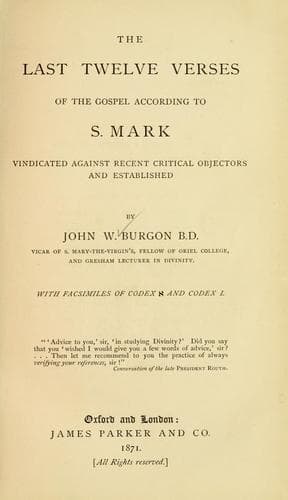
The Last Twelve Verses of the Gospel According to S. MarkBurgon, John William
Religion
The Last Twelve Verses of the Gospel According to S. Mark
Burgon, John William
Bible. Mark XVI, 9-20 -- Criticism, Textual
To insist upon this, however, is not at all my present purpose. About the
true reading of S. Luke ii. 14, (which is _not_ the reading of Lachmann,
Tischendorf, Tregelles, Alford,) there is clearly no longer any room for
doubt. It is perhaps one of the best established readings in the whole
compass of the New Testament. My sole object is to call attention to the
two following facts:—
(1) That _the four oldest Codices which contain S. Luke_ ii. 14 (B, א, A,
D, A.D. 320-520), and two of the oldest Versions, conspire in exhibiting
the Angelic Hymn _incorrectly_.
(2) That we are indebted to _fourteen of the Fathers_ (A.D. 240-434), and
to the rest of the ancient Versions, for the true reading of that
memorable place of Scripture.
II. Against all this, it is urged (by Tischendorf) that,—
1. IRENÆUS sides with the oldest uncials.—Now, the Greek of the place
referred to is lost. A Latin translation is all that survives. According
to _that_ evidence, Irenæus, having quoted the place in conformity with
the Vulgate reading (iii. c. x. § 41,—“_Gloria in excelsis Deo et in terra
pax hominibus bonae voluntatis_,”) presently adds,—“In eo quod dicunt,
_Gloria in altissimis __DEO__ et in terra pax_, eum qui sit altissimorum,
hoc est, supercaelestium factor et eorum, quae super terram omnium
conditor, his sermonibus glorificaverunt; qui suo plasmati, hoc est
hominibus suam benignitatem salutis de caelo misit.” (_ed._ Stieren, i.
459).—But it must suffice to point out (1) that these words really prove
nothing: and (2) that it would be very unsafe to build upon them, even if
they did; since (3) it is plain that the Latin translator exhibits the
place in the Latin form most familiar to himself: (consider his
substitution of “excelsis” for “altissimis.”)
2. Next, ORIGEN is claimed on the same side, on the strength of the
following passage in (Jerome’s version of) his lost Homilies on S.
Luke:—“Si scriptum esset, _Super terram pax_, et hucusque esset finita
sententia, recte quaestio nasceretur. Nunc vero in eo quod additum est,
hoc est, quod post pacem dicitur, _In hominibus bonae voluntatis_, solvit
quaestionem. Pax enim quam non dat Dominus super terram, non est pax bonae
voluntatis.” (_Opp._ iii. p. 946.) “From this,” (says Tischendorf, who is
followed by Tregelles,) “it is plain that Origen regarded εὐδοκίας as the
true reading; not εὐδοκία—which is now thrice found in his Greek
writings.”—But,
Public-domain text, read in full here on John Shaqi.
Reviews
Reviews
No reviews yet
Be the first to share your thoughts on this work.
Elsewhere in the archive
Join the Discussion
Join the discussion
Sign in to leave a comment or review.
Sign InorCreate an account