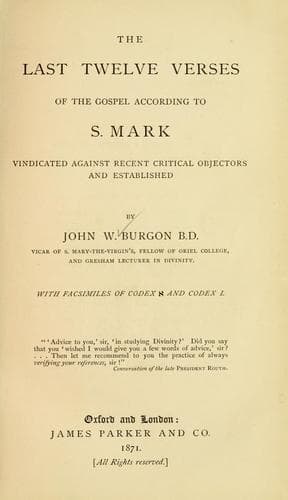
The Last Twelve Verses of the Gospel According to S. MarkBurgon, John William
Religion
The Last Twelve Verses of the Gospel According to S. Mark
Burgon, John William
Bible. Mark XVI, 9-20 -- Criticism, Textual
Is one here more struck with the unfairness of the Critic, or with the
feebleness of his reasoning? For,—(to say nothing of the insecurity of
building on a Latin Translation,(502) especially in such a matter as the
present,)—How can testimony like this be considered to outweigh the three
distinct places in the original writings of this Father, where he reads
not εὐδοκίας but εὐδοκία? Again. Why is a doubt insinuated concerning the
trustworthiness of those three places, (“ut _nunc_ reperitur,”) where
there really is _no_ doubt? How is Truth ever to be attained if
investigations like the present are to be conducted in the spirit of an
eager partisan, instead of with the calm gravity of an impartial judge?
But I may as well state plainly that the context of the passage above
quoted shews that Tischendorf’s proposed inference is inadmissible. Origen
is supposing some one to ask the following question:—“Since Angels on the
night when CHRIST was born proclaimed ‘on earth _Peace_,’—why does our
SAVIOUR say, ‘I am _not_ come to send Peace upon earth, but a sword?’...
Consider,” (he proceeds) “whether the answer may not be this:”—and then
comes the extract given above. Origen, (to express oneself with colloquial
truthfulness,) is _at his old tricks_. He is evidently acquainted with the
reading εὐδοκίας: and because it enables him to offer (what appears to
him) an ingenious solution of a certain problem, he adopts it for the
nonce: his proposal to take the words εἰρήνη εὐδοκίας together, being
simply preposterous,—as no one ever knew better than Origen himself.(503)
3. Lastly, CYRIL OF JERUSALEM is invariably cited by the latest Critics as
favouring the reading εὐδοκίας. Those learned persons have evidently
overlooked the candid acknowledgment of De Touttée, Cyril’s editor, (p.
180, cf. bottom of p. 102,) that though _the MSS. of Cyril_ exhibit
εὐδοκία, yet in his editorial capacity he had ventured _to print_
εὐδοκίας. This therefore is one more Patristic attestation to the
trustworthiness of the Textus Receptus in respect of S. Luke ii. 14, which
has been hitherto unaccountably lost sight of by Critics. (May I, without
offence, remind Editors of Scripture that instead of _copying_, they ought
in every instance _to verify_ their references?)
III. The history of this corruption of the Text is not hard to discover.
It is interesting and instructive also.
(1.) In the immediately post-Apostolic age,—if not earlier still,—some
Copyist will have omitted the ἐν before ἀνθρώποις. The resemblance of the
letters and the similarity of the sound (ΕΝ, ΑΝ,) misled him:—
ΕΝΑΝΘΡΩΠΟΙΣ
Every one must see at a glance how easily the thing may have happened. (It
is in fact precisely what _has_ happened in Acts iv. 12; where, for ἐν
ἀνθρώποις, D and a few cursive MSS. read ἀνθρώποις,—being countenanced
therein by the Latin Versions generally, and by them only.)
Public-domain text, read in full here on John Shaqi.
Reviews
Reviews
No reviews yet
Be the first to share your thoughts on this work.
Elsewhere in the archive
Join the Discussion
Join the discussion
Sign in to leave a comment or review.
Sign InorCreate an account