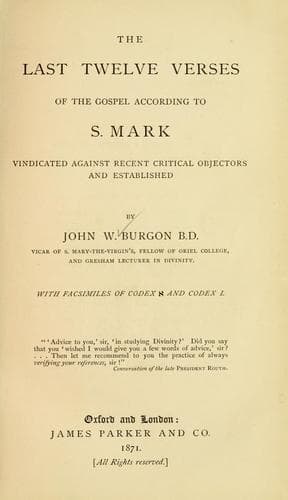
The Last Twelve Verses of the Gospel According to S. MarkBurgon, John William
Religion
The Last Twelve Verses of the Gospel According to S. Mark
Burgon, John William
Bible. Mark XVI, 9-20 -- Criticism, Textual
But this assumption, (that a work which has been held to be a complete
work for seventeen centuries and upwards was originally incomplete,) of
course requires _proof_. The foregoing improbable theories, based on a
gratuitous assumption, are confronted _in limine_ with a formidable
obstacle which must be absolutely got rid of before they can be thought
entitled to a serious hearing. It is a familiar and a fatal circumstance
that the Gospel of S. Mark has been furnished with its present termination
ever since the second century of the Christian æra.(24) In default,
therefore, of distinct historical evidence or definite documentary proof
that _at some earlier period than that_ it terminated abruptly, nothing
short of the utter unfitness of the verses which at present conclude S.
Mark’s Gospel to be regarded as the work of the Evangelist, would warrant
us in assuming that they are the spurious accretion of the post-apostolic
age: and as such, at the end of eighteen centuries, to be deliberately
rejected. We must absolutely be furnished, I say, with internal evidence
of the most unequivocal character; or else with external testimony of a
direct and definite kind, if we are to admit that the actual conclusion of
S. Mark’s Gospel is an unauthorized substitute for something quite
different that has been lost. I can only imagine one other thing which
could induce us to entertain such an opinion; and that would be the
_general_ consent of MSS., Fathers, and Versions in leaving these verses
out. Else, it is evident that we are logically _forced_ to adopt the far
easier supposition that (_not_ S. Mark, but) _some copyist of the third
century_ left a copy of S. Mark’s Gospel unfinished; which unfinished copy
became the fontal source of the mutilated copies which have come down to
our own times.(25)
I have thought it right to explain the matter thus fully at the outset;
not in order to prejudge the question, (for _that_ could answer no good
purpose,) but only in order that the reader may have clearly set before
him the real nature of the issue. “Is it reasonable to suspect that the
concluding verses of S. Mark are a spurious accretion and unauthorized
supplement to his Gospel, or not?” _That_ is the question which we have to
consider,—the _one_ question. And while I proceed to pass under careful
review all the evidence on this subject with which I am acquainted, I
shall be again and again obliged to direct the attention of my reader to
its bearing on the real point at issue. In other words, we shall have
again and again to ask ourselves, how far it is rendered probable by each
fresh article of evidence that S. Mark’s Gospel, when it left the hands of
its inspired Author, was an unfinished work; the last chapter ending
abruptly at ver. 8?
Public-domain text, read in full here on John Shaqi.
Reviews
Reviews
No reviews yet
Be the first to share your thoughts on this work.
Join the Discussion
Join the discussion
Sign in to leave a comment or review.
Sign InorCreate an account