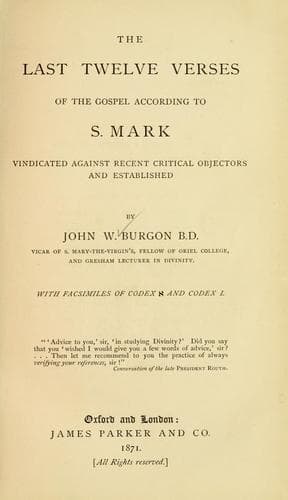
The Last Twelve Verses of the Gospel According to S. MarkBurgon, John William
Religion
The Last Twelve Verses of the Gospel According to S. Mark
Burgon, John William
Bible. Mark XVI, 9-20 -- Criticism, Textual
Of Origen also Victor was evidently very fond(519): and his words on two
or three occasions seem to shew that he had recourse besides habitually to
the exegetical labours of Apolinarius, Theodore of Mopsuestia, and Titus
of Bostra.(520) Passages from Cyril of Alexandria are occasionally met
with;(521) and once at least (p. 370) he has an extract from Basil. The
historian Josephus he sometimes refers to by name.(522)
But the Father to whom Victor is chiefly indebted is Chrysostom,—whom he
styles “the blessed John, Bishop of the Royal City;” (meaning
Constantinople(523)). Not that Victor, strictly speaking, _transcribes_
from Chrysostom; at least, to any extent. His general practice is slightly
to adapt his Author’s language to his own purpose; sometimes, to leave out
a few words; a paragraph; half a page.(524) Then, he proceeds to quote
another Father probably; or, it may be, to offer something of his own. But
he seldom gives any intimation of what it is he does: and if it were not
for the occasional introduction of the phrase ὁ μέν φησι or ἄλλος δέ
φησι,(525) a reader of Victor’s Commentary might almost mistake it for an
original composition. So little pains does this Author take to let his
reader know when he is speaking in his own person, when not, that he has
not scrupled to retain Chrysostom’s phrases ἐγὼ δὲ οἶμαι,(526) &c. The
result is that it is often impossible to know to _whose_ sentiments we are
listening. It cannot be too clearly borne in mind that ancient ideas
concerning authorship differed entirely from those of modern times;
especially when Holy Scripture was to be commented on.
I suspect that, occasionally, copyists of Victor’s work, as they
recognised a fragment here and there, prefixed to it the name of its
author. This would account for the extremely partial and irregular
occurrence of such notes of authorship; as well as explain why a name duly
prefixed in one copy is often missing in another.(527) Whether Victor’s
Commentary can in strictness be called a “Catena,” or not, must remain
uncertain until some one is found willing to undertake the labour of
re-editing his pages; from which, by the way, I cannot but think that some
highly interesting (if not some important) results would follow.
Yet, inasmuch as Victor never, or certainly very seldom, prefixes to a
passage from a Father _the name of its Author_;—above all, seeing that
sometimes, at all events, he is original, or at least speaks in his own
person;—I think the title of “Catena” inappropriate to his Commentary.
Public-domain text, read in full here on John Shaqi.
Reviews
Reviews
No reviews yet
Be the first to share your thoughts on this work.
Elsewhere in the archive
Join the Discussion
Join the discussion
Sign in to leave a comment or review.
Sign InorCreate an account