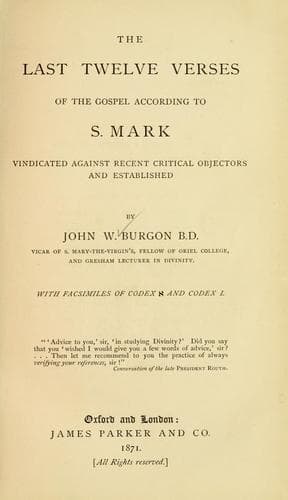
The Last Twelve Verses of the Gospel According to S. MarkBurgon, John William
Religion
The Last Twelve Verses of the Gospel According to S. Mark
Burgon, John William
Bible. Mark XVI, 9-20 -- Criticism, Textual
It is obvious to suggest that after familiarizing ourselves with this
specimen of what proves to have been the licentious method of the ancient
copyists in respect of the text of an early Father, we are in a position
to approach more intelligently the Commentary of Victor itself; and, to
some extent, to understand how it comes to pass that so many liberties
have been taken with it throughout. The Reader is reminded of what has
been already offered on this subject at pp. 272-3.
APPENDIX (F).
On the Relative antiquity of the CODEX VATICANUS (B), and the
CODEX SINAITICUS (א).
(Referred to at p. 70.)
I. “Vix differt aetate a Codice Sinaitico,” says Tischendorf, (_ed. 8va_,
1869, p. ix,) speaking of the Codex Vaticanus (B). Yet does he perpetually
designate his own Sinaitic Codex (א) as “omnium antiquissimus.” Now,
(1) The (all but unique) sectional division of the Text of Codex
B,—confessedly the oldest scheme of chapters extant, is in itself a
striking note of primitiveness. The author of the Codex knew nothing,
apparently, of the Eusebian method. But I venture further to suggest that
the following peculiarities in Codex א unmistakably indicate for it a
later date than Codex B.
(2) Cod. א, (like C, and other later MSS.,) is broken up into short
paragraphs throughout. The Vatican Codex, on the contrary, has very few
breaks indeed: e.g. it is without break of any sort from S. Matth. xvii.
24 to xx. 17: whereas, within the same limits, there are in Cod. א as many
as _thirty_ interruptions of the context. From S. Mark xiii. 1 to the end
of the Gospel the text is absolutely continuous in Cod. B, except in _one_
place: but in Cod. א it is interrupted upwards of _fifty_ times. Again:
from S. Luke xvii. 11, to the end of the Gospel there is but _one_ break
in Cod. B. But it is broken into well nigh _an hundred and fifty_ short
paragraphs in Cod. א.
There can be no doubt that the unbroken text of Codex B, (resembling the
style of the papyrus of _Hyperides_ published by Mr. Babington,) is the
more ancient. The only places where it approximates to the method of Cod.
א, is where the Commandments are briefly recited (S. Matth. xix. 18, &c.),
and where our LORD proclaims the eight Beatitudes (S. Matth. v.)
(3) Again; Cod. א is prone to exhibit, on extraordinary occasions, _a
single word_ in a line, as at—
S. MATTH. XV. 30.
ΧΩΛΟΥΣ
ΤΥΦΛΟΥΣ
ΚΥΛΛΟΥΣ
ΚΩΦΟΥΣ
S. MARK X. 29.
Η ΑΔΕΛΦΑΣ
Η ΠΑΤΕΡΑ
Η ΜΗΤΕΡΑ
Η ΤΕΚΝΑ
Η ΑΓΡΟΥΣ
S. LUKE XIV. 13
ΠΤΩΧΟΥΣ
ΑΝΑΠΗΡΟΥΣ
ΧΩΛΟΥΣ
ΤΥΦΛΟΥΣ
This became a prevailing fashion in the vith century; e.g. when the Cod.
Laudianus of the Acts (E) was written. The only trace of anything of the
kind in Cod. B is at the Genealogy of our LORD.
Public-domain text, read in full here on John Shaqi.
Reviews
Reviews
No reviews yet
Be the first to share your thoughts on this work.
Elsewhere in the archive
Join the Discussion
Join the discussion
Sign in to leave a comment or review.
Sign InorCreate an account