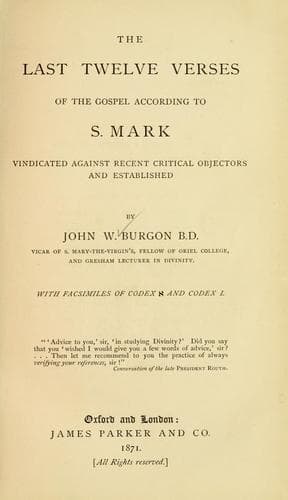
The Last Twelve Verses of the Gospel According to S. MarkBurgon, John William
Religion
The Last Twelve Verses of the Gospel According to S. Mark
Burgon, John William
Bible. Mark XVI, 9-20 -- Criticism, Textual
To conclude.—That the “Diatessaron” of Tatian, (for so, according to
Eusebius and Theodoret, Tatian himself styled it,) has long since
disappeared, no one now doubts.(578) That Eusebius himself, (who lived 150
years after the probable date of its composition,) had never seen it, may
I suppose be inferred from the terms in which he speaks of it. Jerome does
not so much as mention its existence. Epiphanius, who is very full and
particular concerning the heresy of Tatian, affords no indication that he
was acquainted with his work. On the contrary. “The Diatessaron Gospel,”
(he remarks in passing,) “which some call the Gospel according to the
Hebrews, is said to have been the production of this writer.”(579) The
most interesting notice we have of Tatian’s work is from the pen of
Theodoret. After explaining that Tatian the Syrian, originally a Sophist,
and next a disciple of Justin Martyr [A.D. 150], after Justin’s death
aspired to being a heretical leader,—(statements which are first found in
Irenæus,)—Theodoret enumerates his special tenets. “This man” (he
proceeds) “put together the so-called _Diatessaron Gospel_,—from which he
cut away the genealogies, and whatever else shews that the LORD was born
of the seed of David. The book was used not only by those who favoured
Tatian’s opinions, but by the orthodox as well; who, unaware of the
mischievous spirit in which the work had been executed, in their
simplicity used the book as an epitome. _I myself found upwards of two
hundred such copies honourably preserved in the Churches of this place_,”
(Cyrus in Syria namely, of which Theodoret was made Bishop, A.D.
423,)—“all of which I collected together, and put aside; substituting the
Gospels of the Four Evangelists in their room.”(580)
The diocese of Theodoret (he says) contained eight hundred Parishes.(581)
It cannot be thought surprising that a work of which copies had been
multiplied to such an extraordinary extent, and which was evidently once
held in high esteem, should have had _some_ influence on the text of the
earliest Codices; and here, side by side with a categorical statement as
to one of its licentious interpolations, we are furnished with documentary
proof that many an early MS. also was infected with the same taint. To
assume that the two phenomena stand related to one another in the way of
cause and effect, seems to be even an inevitable proceeding.
I will not prolong this note by inquiring concerning the “Diodorus” of
whom the unknown author of this scholion speaks: but I suppose it was
_that_ Diodorus who was made Bishop of Tarsus in A.D. 378. He is related
to have been the preceptor of Chrysostom; was a very voluminous writer;
and, among the rest, according to Suidas, wrote a work “on the Four
Gospels.”
Public-domain text, read in full here on John Shaqi.
Reviews
Reviews
No reviews yet
Be the first to share your thoughts on this work.
Elsewhere in the archive
Join the Discussion
Join the discussion
Sign in to leave a comment or review.
Sign InorCreate an account