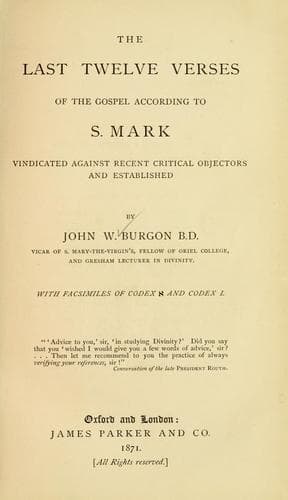
The Last Twelve Verses of the Gospel According to S. MarkBurgon, John William
Religion
The Last Twelve Verses of the Gospel According to S. Mark
Burgon, John William
Bible. Mark XVI, 9-20 -- Criticism, Textual
Lastly,—How about the singular introduction _into the Lection for
Good-Friday_ of this incident of the piercing of the REDEEMER’S side? Is
it allowable to conjecture that, indirectly, the Diatessaron of Tatian may
have been the occasion of that circumstance also; as well as of certain
other similar phenomena in the Evangeliaria?
POSTSCRIPT.
(PROMISED AT p. 51.)
I proceed to fulfil the promise made at p. 51.—C.F. Matthaei (_Nov.
Test._, 1788, vol. iii. p. 269) states that in one of the MSS. at Moscow
occurs the following “Scholion of EUSEBIUS:—κατὰ Μάρκον μετὰ τῆν ἀνάστασιν
οὐ λέγεται ὤφθαι τοῖς μαθηταῖς.” On this, Griesbach remarks (_Comm. Crit._
ii. 200),—“quod scribere non potuisset si pericopam dubiam agnovisset:”
the record in S. Mark xvi. 14, being express,—Ὕστερον ἀνακειμένοις αὐτοῖς
τοῖς ἕνδεκα ἐφανερώθη. The epigrammatic smartness of Griesbach’s dictum
has recommended it to Dr. Tregelles and others who look unfavourably on
the conclusion of S. Mark’s Gospel; and to this hour the Scholion of
Matthaei remains unchallenged.
But to accept the proposed inference from it, is impossible. It ought to
be obvious to every thoughtful person that problems of this class will not
bear to be so handled. It is as if one were to apply the rigid
mathematical method to the ordinary transactions of daily life, for which
it is clearly unsuitable. Before we move a single step, however, we desire
a few more particulars concerning this supposed evidence of Eusebius.
Accordingly, I invoked the good offices of my friend, the Rev. W. G.
Penny, English Chaplain at Moscow, to obtain for me _the entire context_
in which this “Scholion of Eusebius” occurs: little anticipating the
trouble I was about to give him. His task would have been comparatively
easy had I been able to furnish him (which I was not) with the exact
designation of the Codex required. At last by sheer determination and the
display of no small ability, he discovered the place, and sent me a
tracing of the whole page: viz. fol. 286 (the last ten words being
overleaf) of Matthaei’s “12,” (“Synod. 139,”) our EVAN. 255.
It proves to be the concluding portion of Victor’s Commentary, and to
correspond with what is found at p. 365 of Possinus, and p. 446-7 of
Cramer: except that after the words “ἀποκυλίσειε τὸν λίθον,” and before
the words “ἄλλος δέ φησιν” [Possinus, _line_ 12 _from bottom_: Cramer,
_line_ 3 _from the top_], is read as follows:—
οχολ εὐσεβίου
κατὰ Μάρκον: μετὰ τὴν ἀνάστασιν οὐ λέγεται ὦφθαι τοῖς μαθηταῖς: κατὰ
Ματθαῖον: μετὰ τὴν ἀνάστασιν τοῖς μαθηταῖς ὤφθη ἐν τῇ Γαλιλαίᾳ.
κατὰ Ἰωάννην: ἐν αὐτῇ τῇ ἡμέρᾳ τῆς ἀναστάσεως τῶν θυρῶν κεκλεισμένων ὁ
Ἰησοῦς μέσος τῶν μαθητῶν μὴ παρόντος τοῦ Θωμᾶ ἔστη; καὶ μεθ᾽ ἡμέρας πάλιν
ὀκτὼ συμπαρόντος καὶ τοῦ Θωμᾶ. μετὰ ταῦτα πάλιν ἐφάνη αὐτοῖς ἐπὶ τῆς
θαλασσης τῆς Τιβεριάδος.
Public-domain text, read in full here on John Shaqi.
Reviews
Reviews
No reviews yet
Be the first to share your thoughts on this work.
Elsewhere in the archive
Join the Discussion
Join the discussion
Sign in to leave a comment or review.
Sign InorCreate an account