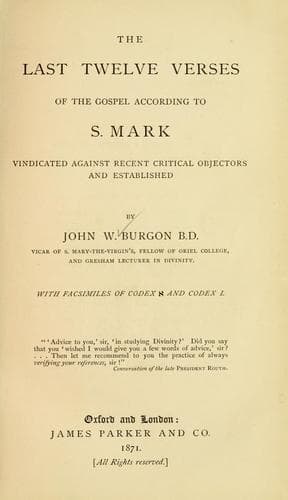
The Last Twelve Verses of the Gospel According to S. MarkBurgon, John William
Religion
The Last Twelve Verses of the Gospel According to S. Mark
Burgon, John William
Bible. Mark XVI, 9-20 -- Criticism, Textual
κατὰ Λουκᾶν: ὤφθη Κλεόπᾳ σὺν τῷ ἑταίρῳ αὐτοῦ αὐτῇ τῇ ἡμέρᾳ τῆς ἀναστάσεως:
καὶ πάλιν ὑποστρέψασιν εἰς Ἱερουσαλὴμ ὤφθη τῇ αὐτῇ ἡμέρᾳ συνηγμένων τῶν
λοιπῶν μαθητῶν: καὶ ὤφθη Σίμωνι: καὶ πάλιν ἐξήγαγεν αὐτοὺς εἰς Βηθανίαν
καὶ διέστη ἀπ᾽ αὐτῶν.
But surely no one who considers the matter attentively, will conceive that
he is warranted in drawing from this so serious an inference as that
Eusebius disallowed the last Section of S. Mark’s Gospel.
(1.) In the first place, we have already [_suprà_, p. 44] heard Eusebius
elaborately discuss the Section in question. That he allowed it, is
therefore _certain_.
(2.) But next, this σχόλιον εὐσεβίου at the utmost can only be regarded as
a general summary of what Eusebius has somewhere delivered concerning our
LORD’S appearances after His Resurrection. _As it stands_, it clearly is
not the work of Eusebius.
(3.) And because I shall be reminded that such a statement cannot be
accepted on my own mere “ipse dixit,” I proceed to subjoin the original
Scholion of which the preceding is evidently only an epitome. It is found
in three of the Moscow MSS., (our Evan. 239, 259, 237,) but without any
Author’s name:—
Δεικνὺς δὲ ὁ εὐαγγελιστὴς, ὅτι μετὰ τὴν ἀνάστασιν οὐκέτι συνεχῶς αὐτοῖς
συνῆν, λέγει, τοῦτο ἤδη τρίτον _τοῖς μαθηταῖς ὤφθη_ ὁ Κύριος _μετὰ τὴν
ἀνάστασιν;_ οὐ τοῦτο λέγων, ὅτι μόνον τρίτον, ἀλλὰ τὰ τοῖς ἄλλοις
παραλελειμμένα λέγων, τοῦτο ἤδη πρὸς τοῖς ἄλλοις τρίτον ἐφανερώθη τοῖς
μαθηταῖς. _κατὰ_ μὲν γὰρ τὸν _Ματθαῖον,_ ὤφθη αὐτοῖς _ἐν τῇ Γαλιλαιᾳ_
μόνον; _κατὰ_ δὲ τὸν _Ἰωάννην, ἐν αὐτῇ τῇ ἡμέρᾳ τῆς ἀναστάσεως, τῶν θυρῶν
κεκλεισμένων, μέσος_ αὐτῶν _ἔστη_ ὄντων ἐν Ἱερουσαλὴμ, _μὴ παρόντος_ ἐκει
Θωμᾶ. καὶ πάλιν μεθ᾽ ἡμέρας ὀκτὼ, παρόντος καὶ _τοῦ Θωμᾶ,_ ὤφθη αὐτοῖς,
ἤδη κεκλεισμένων τῶν θυρῶν. _μετὰ ταῦτα ἐπὶ τῆς θαλάσσης τῆς Τιβεριάδος
ἐφάνη αὐτοῖς,_ ού τοῖς ΙΑ ἀλλὰ μόνοις ζ. _κατὰ_ δὲ _Λουκᾶν ὤφθη Κλεόπᾳ σὺν
τῷ ἑταίρῳ αὐτοῦ, αὐτῇ τῇ ἡμέρᾳ τῆς ἀναστάσεως. καὶ πάλιν ὑποστρέψασιν εἰς
Ἱερουσαλὴμ αὐτῇ τῇ ἡμέρᾳ, συνηγμένων τῶν μαθητῶν, ὤφθη Σίμωνι. καὶ πάλιν
ἐξαγαγὼν αὐτοὺς εἰς Βηθανίαν,_ ὅτε _καὶ διέστη_ ἀναληφθεὶς _ἀπ᾽ αὐτῶν;_ ὡς
ἐκ τοῦτου παρίστασθαι ζ. εἶναι τοὺς μαθητὰς μετὰ τὴν ἀνάστασιν γεγονυίας
ὀπτασίας τοῦ Σωτῆρος ἡμῶν Ἰησοῦ Χριστοῦ. μίαν μὲν παρὰ τῷ Ματθαίῳ, τρεῖς
δὲ παρὰ τῷ Ἰώαννῃ, καὶ τρεῖς τῷ Λουκᾷ ὁμοίως.(582)
(4.) Now, the chief thing deserving of attention here,—the _only_ thing in
fact which I am concerned to point out,—is the notable circumstance that
the supposed dictum of Eusebius,—(“quod scribere non potuisset si
pericopam dubiam agnovisset,”)—_is no longer discoverable_. To say that
“it has disappeared,” would be incorrect. In the original document _it has
no existence_. In plain terms, the famous “σχόλιον εὐσεβίου” proves to be
every way a figment. It is a worthless interpolation, thrust by some
nameless scribe into his abridgement of a Scholion, of which Eusebius (as
I shall presently shew) _cannot_ have been the Author.
Public-domain text, read in full here on John Shaqi.
Reviews
Reviews
No reviews yet
Be the first to share your thoughts on this work.
Elsewhere in the archive
Join the Discussion
Join the discussion
Sign in to leave a comment or review.
Sign InorCreate an account