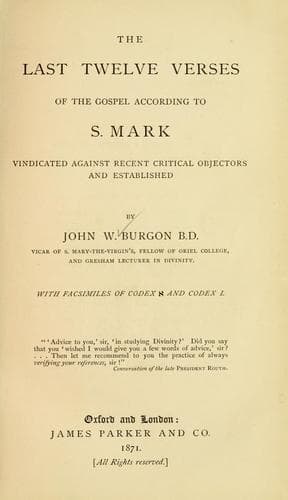
The Last Twelve Verses of the Gospel According to S. MarkBurgon, John William
Religion
The Last Twelve Verses of the Gospel According to S. Mark
Burgon, John William
Bible. Mark XVI, 9-20 -- Criticism, Textual
6. For let it be only considered what is implied by a Patristic appeal to
the Gospel. It amounts to this:—that a conspicuous personage, probably a
Bishop of the Church,—one, therefore, whose history, date, place, are all
more or less matter of notoriety,—gives us his written assurance that the
passage in question was found in that copy of the Gospels which he was
accustomed himself to employ; _the uncial codex_, (it has long since
perished) _which belonged to himself_ or to the Church which he served. It
is evident, in short, that any objection to quotations from Scripture in
the writings of the ancient Fathers can only apply to the form of those
quotations; not to their _substance_. It is just as certain that a verse
of Scripture was actually read by the Father who unmistakedly refers to
it, as if we had read it with him; even though the gravest doubts may be
entertained as to the “ipsissima verba” which were found in his own
particular copy. He may have trusted to his memory: or copyists may have
taken liberties with his writings: or editors may have misrepresented what
they found in the written copies. The _form_ of the quoted verse, I
repeat, may have suffered almost to any extent. The _substance_, on the
contrary, inasmuch as it lay wholly beyond their province, may be looked
upon as an indisputable _fact_.
7. Some such preliminary remarks, (never out of place when quotations from
the Fathers are to be considered,) cannot well be withheld when the most
venerable Ecclesiastical writings are appealed to. The earliest of the
Fathers are observed to quote with singular licence,—to _allude_ rather
than to quote. Strange to relate, those ancient men seem scarcely to have
been aware of the grave responsibility they incurred when they substituted
expressions of their own for the utterances of the SPIRIT. It is evidently
not so much that their _memory_ is in fault, as their _judgment_,—in that
they evidently hold themselves at liberty to paraphrase, to recast, to
reconstruct.(31)
I. Thus, it is impossible to resist the inference that PAPIAS refers to S.
Mark xvi. 18 when he records a marvellous tradition concerning “Justus
surnamed Barsabas,” “how that after drinking noxious poison, through the
LORD’s grace he experienced no evil consequence.”(32) He does not give
_the words_ of the Evangelist. It is even surprising how completely he
passes them by; and yet the allusion to the place just cited is manifest.
Now, Papias is a writer who lived so near the time of the Apostles that he
made it his delight to collect their traditional sayings. His date
(according to Clinton) is A.D. 100.
Public-domain text, read in full here on John Shaqi.
The Last Twelve Verses of the Gospel According to S. Mark — John Shaqi
Reviews
Reviews
No reviews yet
Be the first to share your thoughts on this work.
Join the Discussion
Join the discussion
Sign in to leave a comment or review.
Sign InorCreate an account