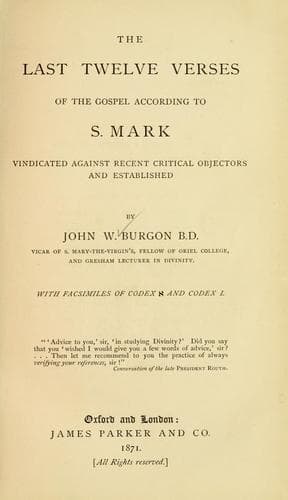
The Last Twelve Verses of the Gospel According to S. MarkBurgon, John William
Religion
The Last Twelve Verses of the Gospel According to S. Mark
Burgon, John William
Bible. Mark XVI, 9-20 -- Criticism, Textual
II. JUSTIN MARTYR, the date of whose first Apology is A.D. 151, is
observed to say concerning the Apostles that, after our LORD’s
Ascension,—ἐξελθόντες πανταχοῦ ἐκήρυξαν:(33) which is nothing else but a
quotation from the last verse of S. Mark’s Gospel,—ἐκεῖνοι δὲ ἐξελθόντες
ἐκήρυξαν πανταχοῦ. And thus it is found that the conclusion of S. Mark’s
Gospel was familiarly known within fifty years of the death of the last of
the Evangelists.
III. When IRENÆUS, in his third Book against Heresies, deliberately quotes
and remarks upon the 19th verse of the last chapter of S. Mark’s
Gospel,(34) we are put in possession of the certain fact that the entire
passage now under consideration was extant in a copy of the Gospels which
was used by the Bishop of the Church of Lyons sometime about the year A.D.
180, and which therefore cannot possibly have been written much more than
a hundred years after the date of the Evangelist himself: while it _may_
have been written by a contemporary of S. Mark, and probably _was_ written
by one who lived immediately after his time.—Who sees not that this single
piece of evidence is in itself sufficient to outweigh the testimony of any
codex extant? It is in fact a mere trifling with words to distinguish
between “Manuscript” and “Patristic” testimony in a case like this: for
(as I have already explained) the passage quoted from S. Mark’s Gospel by
Irenæus is to all intents and purposes _a fragment from a dated
manuscript_; and _that_ MS., demonstrably older by at least one hundred
and fifty years than the oldest copy of the Gospels which has come down to
our times.
IV. Take another proof that these concluding verses of S. Mark were in the
second century accounted an integral part of his Gospel. HIPPOLYTUS,
Bishop of Portus near Borne (190-227), a contemporary of Irenæus, quotes
the 17th and 18th verses in his fragment Περὶ Χαρισμάτων.(35) Also in his
Homily on the heresy of Noetus,(36) Hippolytus has a plain reference to
this section of S. Mark’s Gospel. To an inattentive reader, the passage
alluded to might seem to be only the fragment of a Creed; but this is not
the case. In the Creeds, CHRIST is _invariably_ spoken of as ανελθόντα: in
the Scriptures, _invariably_ as ἀναληθέντα.(37) So that when Hippolytus
says of Him, ἀναλαμβάνεται εἰς οὐρανοὺς καὶ ἐκ δεξιῶν Πατρὸς καθίζεται,
the reference must needs be to S. Mark xvi. 19.
V. At the Seventh COUNCIL OF CARTHAGE held under Cyprian, A.D. 256, (on
the baptizing of Heretics,) Vincentius, Bishop of Thibari, (a place not
far from Carthage,) in the presence of the eighty-seven assembled African
bishops, quoted two of the verses under consideration;(38) and Augustine,
about a century and a half later, in his reply, recited the words
afresh.(39)
Public-domain text, read in full here on John Shaqi.
Reviews
Reviews
No reviews yet
Be the first to share your thoughts on this work.
Join the Discussion
Join the discussion
Sign in to leave a comment or review.
Sign InorCreate an account