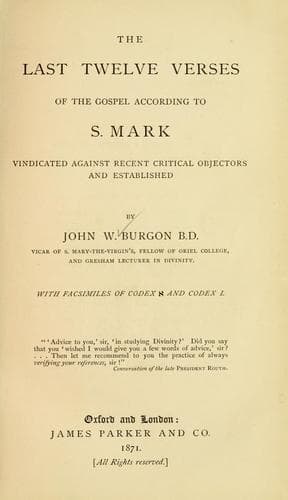
The Last Twelve Verses of the Gospel According to S. MarkBurgon, John William
Religion
The Last Twelve Verses of the Gospel According to S. Mark
Burgon, John William
Bible. Mark XVI, 9-20 -- Criticism, Textual
(Victor.) τὸ μὲν “ἀναστὰς,” ὰναπέμψωμεν ἐπὶ τὴν παρὰ τῷ Ματθαίῳ “ὀψὲ
σαββάτων.” (τότε γὰρ ἐγηγέρθαι αὐτὸν πιστεύομεν.) τὸ δὲ ἑξῆς, ἑτέρας
ὄν διανοίας παραστατικὸν, συνάψωμεν τοῖς ἐπιλεγομένοις;
(Eusebius.) (“πρωί” γὰρ “τῇ μιᾷ τοῦ σαββάτου ἐφάνη Μαρίᾳ τῇ
Μαγδαληνῇ.”)
(Victor.) (τὸν γὰρ “ὀψὲ σαββάτων” κατὰ Ματθαῖον ἐγαγερμένον ἱστορεῖ
“πρωί” ἑωρακέναι Μαρίαν τὴν Μαγδαληνήν.)
(Eusebius.) τοῦτο γοῦν ἐδήλωσε καὶ ὁ Ἰωάννης “πρωί” καί αὐτὸς “τῇ
μιᾷ τοῦ σαββάτου” ὤφθαι αὐτὸν τῇ Μαγδαληνῇ μαρτυρήσας.
(Victor.) τοῦτο γοῦν ἐδήλωσε καὶ Ἰωάννες, “πρωί” καὶ αὐτὸς “τῇ μιᾷ
τῶν σαββάτων” ὤφθαι αὐτὸν τῇ Μαγδαληνῇ μαρτυρήσας.
[31 words here omitted.]
(Eusebius.) ὡς παρίστασθαι ἐν τούτοις καιροὺς δύο; τὸν μὲν γὰρ τῆς
αναστάσεως τὸν “ὀψὲ τοῦ σαββάτου.” τὸν δὲ τῆς τοῦ Σωτῆρος
ἐπιφανείας, τὸν “πρωί.”
(Victor.) ὡς παρίστασθαι ἐν τούτοις καιροὺς δύο; τὸν μὲν τῆς
ἀναστάσεως, τὸν “ὀψὲ τοῦ σαββάτου;” τὸν δὲ τῆς τοῦ Σωτῆρος
ἐπιφανείας, τὸ “προί.”
[EUSEBIUS, _apud Mai_, iv. p. 256.]
[VICTOR ANTIOCH, _ed. Cramer_, i. p. 444-5: (_with a few slight
emendations of the text from_ Evan. Cod. Reg. 178.)]
Note, that Victor _twice_ omits the word πρῶτον, and _twice_ reads
τῇ μιᾷ τοῦ σαββάτου, (instead of πρῶτῃ σαββάτου), _only because
Eusebius had inadvertently_ (three times) _done the same thing_ in
the place from which Victor is copying. See Mai. _Nova P. P. Bibl._
iv. p. 256, line 19 and 26: p. 257 line 4 and 5.
114 οὐκ ἀγνοῶ δἐ ὡς διαφόρους ὀπτασίας γεγενῆσθαί φασιν οἱ τὴν δοκοῦσαν
διαφωνίαν διαλῦσαι σπουδάζοντες. Vict. Ant. _ed. Cramer_, vol. i. p.
445, l. 23-5: referring to what Eusebius says _apud Mai_, iv. 264
and 265 (§ iiii): 287-290 (§§ v, vi, vii.)
115 e.g. in the passage last quoted.
116 For the original of this remarkable passage the reader is referred
to the Appendix (E).
117 How shrewdly was it remarked by Matthaei, eighty years ago,—“Scholia
certe, in quibus de integritate hujus loci dubitatur, omnia _ex uno
fonte promanarunt_. Ex eodem fonte Hieronymum etiam hausisse
intelligitur ex ejus loco quem laudavit Wetst. ad ver. 9.—Similiter
Scholiastæ omnes in principio hujus Evangelii in disputatione de
lectione ἐν ἡσαίᾳ τῷ προφήτη ex uno pendent. _Fortasse Origenes
auctor est hujus dubitationis._” (N.T. vol. ii. p. 270.)—The reader
is invited to remember what was offered above in p. 47 (line 23.)
118 It is not often, I think, that one finds in MSS. a point actually
inserted after Ἀναστάς δέ. Such a point is found, however, in Cod.
34 ( = Coisl. 195,) and Cod. 22 ( = Reg. 72,) and doubtless in many
other copies.
119 Scrivener’s _Introduction_, pp. 47, 125, 431.
Public-domain text, read in full here on John Shaqi.
Reviews
Reviews
No reviews yet
Be the first to share your thoughts on this work.
Elsewhere in the archive
Join the Discussion
Join the discussion
Sign in to leave a comment or review.
Sign InorCreate an account