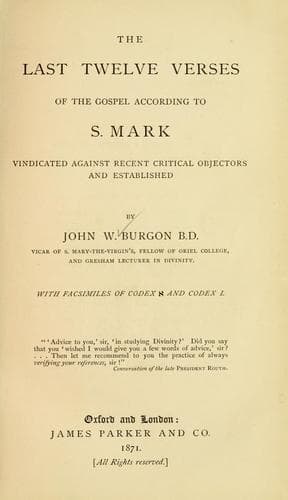
The Last Twelve Verses of the Gospel According to S. MarkBurgon, John William
Religion
The Last Twelve Verses of the Gospel According to S. Mark
Burgon, John William
Bible. Mark XVI, 9-20 -- Criticism, Textual
120 Φασὶ δέ τινες τῶν ἐξηγητῶν ἐνταῦθα συμπληροῦσθαι τὸ κατὰ Μάρκον
εὐαγγέλιον; τὰ δὲ ἐφεξῆς προσθήκην εἶναι μεταγενεστέραν. Χρὴ δὲ καὶ
ταύτην ἑρμηνεῦσαι μηδὲν τῇ ἀληθείᾳ λυμαινομένην.—Euthym. Zig. (_ed._
Matthaei, 1792), _in loc._
121 For some remarks on this subject the reader is referred to the
Appendix (F).
122 Viz. A, C [v]; D [vi]; E, L [viii]; F, K, M, V, Γ, Δ, Λ (quære), Π
[ix]; G, H, X, S, U [ix, x].
123 Vercellone,—_Del antichissimo Codice Vaticano della Bibbia Greca_,
Roma, 1860. (pp. 21.)
_ 124 Dublin Univ. Mag._ (Nov. 1859,) p. 620, quoted by Scrivener, p. 93.
125 ὁμοιοτέλευτον.
126 See Scrivener’s _Introduction_ to his ed. of the Codex Bezæ, p.
xxiii. The passage referred to reappears at the end of his Preface
to the 2nd ed. of his _Collation of the Cod. Sinaiticus_.—Add to his
instances, this from S. Matth. xxviii. 2, 3:—
ΚΑΙ ΕΚΑΘΗΤΟ Ε
ΠΑΝΩ ΑΥΤΟΥ [ΗΝ ΔΕ
Η ΕΙΔΕΑ ΑΥΤΟΥ] ΩΣ
ΑΣΤΡΑΠΗ
It is plain why the scribe of א wrote επανω αυτου ως αστραπη.—The
next is from S. Luke xxiv. 31:—
ΔΙΗΝΥΓΗ
ΣΑΝ ΟΙ ΟΦΘΑΛΜΟΙ
ΚΑΙ [ΕΠΕΓΝΩΣΑΝ ΑΥΤΟ
ΚΑΙ] ΑΥΤΟΣ ΑΦΑΝ
ΤΟΣ ΕΓΕΝΕΤΟ
Hence the omission of και επεγνωσαν αυτον in א.—The following
explains the omission from א (and D) of the Ascension at S. Luke
xxiv. 52:—
ΑΠ ΑΥΤΩΝ ΚΑΙ [ΑΝ
ΕΦΕΡΕΤΟ ΕΙΣ ΤΟΝ
ΟΥΡΑΝΟΝ ΚΑΙ] ΑΥ
ΤΟΙ ΠΡΟΣΚΥΝΗΣΙ
The next explains why א reads περικαλυψαντες επηρωτων in S. Luke
xxii. 64:—
ΔΕΡΟΝΤΕΣ ΚΑΙ ΠΕ
ΠΙΚΑΛΥΨΑΝΤΕΣ Ε
[ΤΥΠΤΟΝ ΑΥΤΟΥ ΤΟ
ΠΡΟΣΩΠΟΝ ΚΑΙ Σ]
ΠΗΡΩΤΩΝ ΑΥΤΟ
The next explains why the words και πας εις αυτην βιαζεται are
absent in א (and G) at S. Luke xvi. 16:—
ΕΥΑΓΓΕ
ΛΙΖΕΤΑΙ [ΚΑΙ ΠΑΣ
ΕΙΣ ΑΥΤΗΝ ΒΙ
ΑΖΕΤΑΙ] ΕΥΚΟΠΩ
ΤΕΡΟΝ ΔΕ ΕΣΤΙΝ ΤΟ
127 In this way, (at S. John xvii. 15, 16), the obviously corrupt
reading of Cod. B (ινα τηρησης αυτους εκ του κοσμου)—which, however,
was the reading of the copy used by Athanasius (_Opp._ p. 1035: _al.
ed._ p. 825)—is explained:—
ΕΚ ΤΟΥ [ΠΟΝΗΡΟΥ.
ΕΚ ΤΟΥ] ΚΟΣΜΟΥ
ΟΥΚ ΕΙΣΙΝ ΚΑΘΩΣ
Thus also is explained why B (with א, A, D, L) omits a precious
clause in S. Luke xxiv. 42:—
ΟΠΤΟΥ ΜΕΡΟΣ ΚΑΙ
[ΑΠΟ ΜΕΛΙΣΣΙ
ΟΥ ΚΗΡΙΟΥ ΚΑΙ]
ΛΑΒΩΝ ΕΝΩΠΙΟΝ
And why the same MSS. (all but A) omit an important clause in S.
Luke xxiv. 53:—
ΕΝ ΤΩ ΙΕΡΩ [ΑΙΝ
ΟΥΝΤΕΣ ΚΑΙ] ΕΥΛΟ
ΓΟΥΝΤΕΣ ΤΟΝ ΘΗΟΝ
And why B (with א, L) omits an important clause in the history of
the Temptation (S. Luke iv. 5) :—
ΚΑΙ ΑΝΑΓΑΓΩΝ ΑΥ
ΤΟΝ [ΕΙΣ ΟΡΟΣ ΥΨΗ
ΛΟΝ] ΕΔΙΞΕΝ ΑΥΤΩ
128 In this way the famous omission (א, B, L) of the word δευτεροπρώτῳ,
in S. Luke vi. 1, is (to say the least) capable of being explained:—
ΕΓΕΝΕΤΟ Δ Ε ΕΝ ΣΑΘ
ΒΑΤΩ Δ[ΕΥΤΕΡΟ
ΠΡΩΤΩ Δ]ΙΑΠΟΡΕΥΕ
Public-domain text, read in full here on John Shaqi.
Reviews
Reviews
No reviews yet
Be the first to share your thoughts on this work.
Elsewhere in the archive
Join the Discussion
Join the discussion
Sign in to leave a comment or review.
Sign InorCreate an account