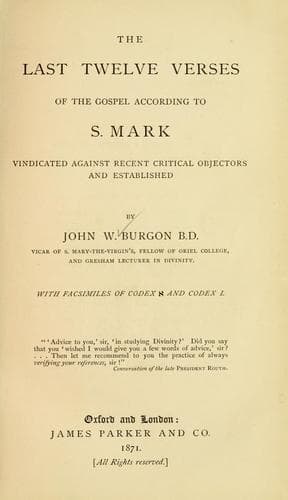
The Last Twelve Verses of the Gospel According to S. MarkBurgon, John William
Religion
The Last Twelve Verses of the Gospel According to S. Mark
Burgon, John William
Bible. Mark XVI, 9-20 -- Criticism, Textual
VI. The Apocryphal ACTA PILATI (sometimes called the “Gospel of
Nicodemus”) Tischendorf assigns without hesitation to the iiird century;
whether rightly or wrongly I have no means of ascertaining. It is at all
events a very ancient forgery, and it contains the 15th, 16th, 17th and
18th verses of this chapter.(40)
VII. This is probably the right place to mention that ver. 15 is clearly
alluded to in two places of the (so-called) “APOSTOLICAL
CONSTITUTIONS;”(41) and that verse 16 is quoted (with no variety of
reading from the _Textus Receptus_(42)) in an earlier part of the same
ancient work. The “Constitutions” are assigned to the iiird or the ivth
century.(43)
VIII and IX. It will be shewn in Chapter V. that EUSEBIUS, the
Ecclesiastical Historian, was profoundly well acquainted with these
verses. He discusses them largely, and (as I shall prove in the chapter
referred to) was by no means disposed to question their genuineness. His
Church History was published A.D. 325.
MARINUS also, (whoever that individual may have been,) a contemporary of
Eusebius,—inasmuch as he is introduced to our notice by Eusebius himself
as asking a question concerning the last twelve verses of S. Mark’s Gospel
without a trace of misgiving as to the genuineness of that about which he
inquires,—is a competent witness in their favor who has hitherto been
overlooked in this discussion.
X. Tischendorf and his followers state that Jacobus Nisibenus quotes these
verses. For “Jacobus Nisibenus” read “APHRAATES the Persian Sage,” and the
statement will be correct. The history of the mistake is curious.
Jerome, in his Catalogue of Ecclesiastical writers, makes no mention of
Jacob of Nisibis,—a famous Syrian Bishop who was present at the Council of
Nicæa, A.D. 325. Gennadius of Marseille, (who carried on Jerome’s list to
the year 495) asserts that the reason of this omission was Jerome’s
ignorance of the Syriac language; and explains that Jacob was the author
of twenty-two Syriac Homilies.(44) Of these, there exists a very ancient
Armenian translation; which was accordingly edited as the work of Jacobus
Nisibenus with a Latin version, at Rome, in 1756. Gallandius reprinted
both the Armenian and the Latin; and to Gallandius (vol. v.) we are
referred whenever “Jacobus Nisibenus” is quoted.
But the proposed attribution of the Homilies in question,—though it has
been acquiesced in for nearly 1400 years,—is incorrect. Quite lately the
Syriac originals have come to light, and they prove to be the work of
Aphraates, “the Persian Sage,”—a Bishop, and the earliest known Father of
the Syrian Church. In the first Homily, (which bears date A.D. 337),
verses 16, 17, 18 of S. Mark xvi. are quoted,(45)—yet not from the version
known as the Curetonian Syriac, nor yet from the Peshito
exactly.(46)—Here, then, is another wholly independent witness to the last
twelve verses of S. Mark, coeval certainly with the two oldest copies of
the Gospel extant,—B and א.
Public-domain text, read in full here on John Shaqi.
Reviews
Reviews
No reviews yet
Be the first to share your thoughts on this work.
Join the Discussion
Join the discussion
Sign in to leave a comment or review.
Sign InorCreate an account