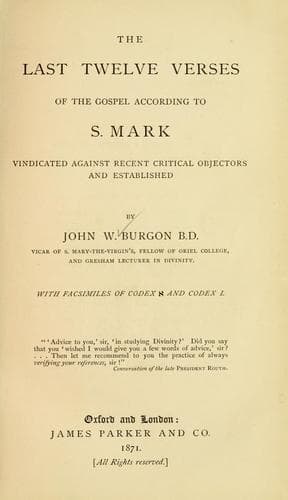
The Last Twelve Verses of the Gospel According to S. MarkBurgon, John William
Religion
The Last Twelve Verses of the Gospel According to S. Mark
Burgon, John William
Bible. Mark XVI, 9-20 -- Criticism, Textual
188 One is rather surprised to find the facts of the case so unfairly
represented in addressing unlearned readers; who are entitled to the
largest amount of ingenuousness, and to entire sincerity of
statement. The facts are these:—
(1) Valentt. (_apud_ Irenæum), (2) Clemens Alex., and (3) Theodotus
(_apud_ Clem.) read ἔστι: but then (1) Irenæus himself, (2) Clemens
Alex., and (3) Theodotus (_apud_ Clem.) _also_ read ἦν. These
testimonies, therefore, clearly neutralize each other. Cyprian also
has _both_ readings.—Hippolytus, on the other hand, reads ἔστι; but
Origen, (though he remarks that ἔστι is “perhaps not an improbable
reading,”) reads ἦν _ten or eleven times_. Ἦν is also the reading of
Eusebius, of Chrysostom, of Cyril, of Nonnus, of Theodoret,—of the
Vulgate, of the Memphitic, of the Peshito, and of the Philoxenian
Versions; as well as of B, A, C,—in fact of _all the MSS. in the
world_, except of א and D.
All that remains to be set on the other side are the Thebaic and
Cureton’s Syriac, together with most copies of the early Latin.
And now, with the evidence thus all before us, will any one say that
it is lawfully a question for discussion which of these two readings
must exhibit the genuine text of S. John i. 4? (For I treat it as a
question of authority, and reason from _the evidence_,—declining to
import into the argument what may be called _logical_
considerations; though I conceive them to be all on my side.) I
suspect, in fact, that the inveterate practice of the primitive age
of reading the place after the following strange fashion,—ὁ γέγονεν
ἐν αὐτῷ ζωὴ ἦν, was what led to this depravation of the text. Cyril
in his Commentary [heading of lib. i, c. vi.] so reads S. John i. 3,
4. And to substitute ἐστί (for ἦν) in such a sentence as _that_, was
obvious.... Chrysostom’s opinion is well known, “Let us beware of
putting the full stop” (he says) “at the words οὐδὲ ἐν,—as do the
heretics.” [He alludes to Valentinus, Heracleon (Orig. _Opp._ i.
130), and to Theodotus (_apud_ Clem. Alex.). But it must be
confessed that Irenæus, Hippolytus (_Routh, Opusc._ i. 68), Clemens
Alex., Origen, Concil. Antioch. (A.D. 269, _Routh_ iii. 293),
Theophilus Antioch., Athanasius, Cyril of Jer.,—besides of the
Latins, Tertullian, Lactantius, Victorinus (_Routh_ iii. 459), and
Augustine,—point the place in the same way. “It is worth our
observation,” (says Pearson,) “that Eusebius citing the place of S.
John to prove that the HOLY GHOST was made by the SON, leaves out
those words twice together by which the Catholics used to refute
that heresy of the Arians, viz. ὁ γέγονεν.”]
Public-domain text, read in full here on John Shaqi.
Reviews
Reviews
No reviews yet
Be the first to share your thoughts on this work.
Elsewhere in the archive
Join the Discussion
Join the discussion
Sign in to leave a comment or review.
Sign InorCreate an account