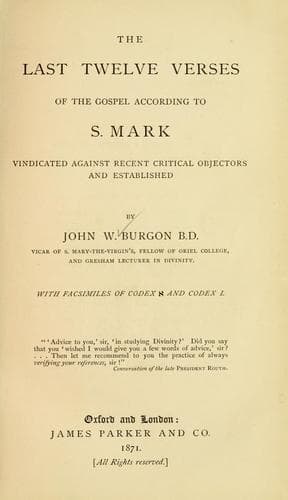
The Last Twelve Verses of the Gospel According to S. MarkBurgon, John William
Religion
The Last Twelve Verses of the Gospel According to S. Mark
Burgon, John William
Bible. Mark XVI, 9-20 -- Criticism, Textual
Chrysostom proceeds,—“In order to make out that THE SPIRIT is a
creature, they read Ὁ γέγονε, ἐν αὐτῳ ζωὴ ἦν; by which means, the
Evangelist’s language is made unintelligible.” (_Opp._ viii.
40.)—This punctuation is nevertheless adopted by Tregelles,—but not
by Tischendorf. The Peshito, Epiphanius (quoted in Pearson’s note,
referred to _infrà_), Cyprian, Jerome and the Vulgate divide the
sentence as we do.—See by all means on this subject Pearson’s _note_
(_z_), ART. viii, (ii. p. 262 ed. Burton). Also Routh’s _Opusc._ i.
88-9.
189 It may not be altogether useless that I should follow this famous
Critic of the text of the N. T. over the ground which he has himself
chosen. He challenges attention for the four following readings of
the Codex Sinaiticus:—
(1.) S. JOHN i. 4: εν αυτω ζωη εστιν.—(2.) S. MATTH. xiii. 35: το
ρηθεν δια ησαιου του προφετου.—(3.) S. JOHN xiii. 10: ο λελουμενος
ουχ εχι χρειαν νιψασθαι.—(4.) S. JOHN vi. 51: αν τις φαγη εκ του
εμου αρυου, ζησει εις τον αιωνα;—ο αρτος ον εγω δωσω υπερ της του
κοσμου ζωης η σαρξ μου εστιν. (And this, Dr. Teschendorf asserts to
be “indubitably correct.”)
On inspection, these four readings prove to be exactly what might
have been anticipated from the announcement that they are almost the
private property of the single Codex א. The last three are
absolutely worthless. They stand self-condemned. To examine is to
reject them: the second (of which Jerome says something _very_
different from what Tisch. pretends) and fourth being only two more
of those unskilful attempts at critical emendation of the inspired
Text, of which this Codex contains so many sorry specimens: the
third being clearly nothing else but the result of the carelessness
of the transcriber. Misled by the like ending (ὁμοιοτέλευτον) he has
_dropped a line_: thus:—
ΟΥΧ ΕΧΙ ΧΡΕΙΑΝ [ΕΙ
ΜΗ ΤΟΥΣ ΠΟΔΑΣ] ΝΙ
ΨΑΣΘΑΙ ΑΛΛΑ ΕΣΤΙΝ
The first, I have discussed briefly in the foregoing footnote (p) p.
110.
190 Scrivener’s _Introduction_, p. 386. The whole Chapter deserves
careful study.
191 Deut. xvi. 19.
_ 192 Printed Text_, p. 254.
193 Viz. Codd. L, 1, 22, 24, 34, 36, 37, 38, 39, 40, 41, 108, 129, 137,
138, 143, 181, 186, 196, 199, 206, 209, 210, 221, 222.
194 Wetstein quoted 14 Codices in all: but Griesbach makes no use of his
reference to Reg. 2868, 1880, and 2282 (leg. 2242?) which = Evan.
15, 19, 299 (?) respectively.
_ 195 Variae Lectiones_, &c. (1801, p. 225-6.)—He cites Codd. Vatt. 358,
756, 757, 1229 (= our 129, 137, 138, 143): Cod. Zelada (= 181):
Laur. vi. 18, 34 (= 186, 195): Ven. 27 (= 210): Vind. Lamb. 38, 89,
Kol. 4 (= 221, 222, 108): Cod. iv. (_leg._ 5 ?) S. Mariæ Bened.
Flor. (= 199): Codd. Ven. 6, 10 (= 206, 209.)
_ 196 Nov. Test._ vol. i. p. 199.
Public-domain text, read in full here on John Shaqi.
Reviews
Reviews
No reviews yet
Be the first to share your thoughts on this work.
Elsewhere in the archive
Join the Discussion
Join the discussion
Sign in to leave a comment or review.
Sign InorCreate an account