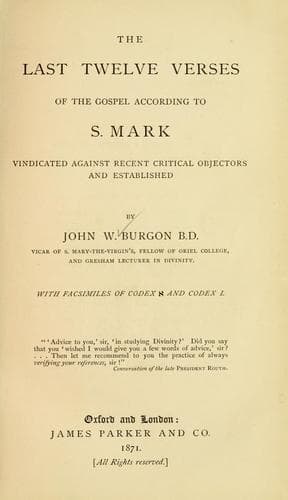
The Last Twelve Verses of the Gospel According to S. MarkBurgon, John William
Religion
The Last Twelve Verses of the Gospel According to S. Mark
Burgon, John William
Bible. Mark XVI, 9-20 -- Criticism, Textual
208 It originated in this way. At the end of S. Matthew’s Gospel, in
both Codices, are found those large extracts from the “2nd Hom. on
the Resurrection” which Montfaucon published in the _Bibl. Coisl._
(pp. 68-75), and which Cramer has since reprinted at the end of his
_Catena in S. Matth._ (i. 243-251.) In Codd. 34 and 39 they are
ascribed to “Severus of Antioch.” See above (p. 40.) See also pp. 39
and 57.
209 See above, pp. 64, 65.
210 22-3 (199, 206, 209) = 19 + 1 (374) = 20.
211 viz. Codd. L, 1, 199, 208, 209:—20, 300:—15, 22.
212 Cod. Λ, 20, 262, 300.
213 Evan. 374.
214 viz. Evan. 24, 36, 37, 40, 41 (Wetstein.) Add Evan. 108, 129, 137,
138, 143, 181, 186, 195, 210, 221, 222. (Birch _Varr. Lectt_. p.
225.) Add Evan. 374 (Scholz.) Add Evan. 12, 129, 299, 329, and the
Moscow Codex (qu. Evan. 253?) employed by Matthaei.
215 2 (viz. Evan. 20, 200) + 16 + 1 + 5 (enumerated in the preceding
note) = 24.
216 Paris 62, _olim,_ 2861 and 1558.
217 See the facsimile.—The original, (which knows nothing of
Tischendorf’s crosses,) reads as follows:—
ΦΕΡΕΤΕ ΠΟΥ
ΚΑΙ ΤΑΥΤΑ
ΠΑΝΤΑ ΔΕ ΤΑ ΠΑΡΗ
ΓΓΕΛΜΕΝΑ ΤΟΙΣ
ΠΕΡΙ ΤΟΝ ΠΕΤΡΟΝ
ΣΥΝΤΟΜΩΣ ΕΞΗ
ΓΓΙΛΑΝ - ΜΕΤΑ
ΔΕ ΤΑΥΤΑ ΚΑΙ ΑΥΤΟΡ
Ο ΙΣ, ΑΠΟ ἈΝΑΤΟΛΗΣ
ΚΑΙ ἈΧΡΙ ΔΥΣΕΩΣ
ἘΞΑΠΕΣΤΙΛΕΝ ΔΙ
ΑΥΤΩΝ ΤΟ ΙΕΡΟΝ
ΚΑΙ ἉΦΘΑΡΤΟΝ ΚΗ
ΡΥΓΜΑ - ΤΗΣ ΑΙΩ
ΝΙΟΥ ΣΩΤΗΡΙΑΣ
ΕΣΤΗΝ ΔΕ ΚΑΙ
ΤΑΥΤΑ ΦΕΡΟ
ΜΕΝΑ ΜΕΤΑ ΤΟ
ΕΦΟΒΟΥΝΤΟ ΓΑΡ
ΑΝΑΣΤΑΣ ΔΕ ΠΡΩΙ
ΠΡΩΤΗ ΣΑΒΒΑΤΩ
_i.e._—φέρεταί που καὶ ταῦτα
Πάντα δὲ τὰ παρηγγελμένα τοῖς περὶ τον Πέτρον συντόμως ἐξήλλειλαν:
μετὰ δὲ ταῦτα καὶ αὐτὸς ὁ Ἰησοῦς ἀπὸ ἀνατολῆς καὶ ἄχρι δύσεως
ἐξαπέστειλεν δι᾽ αὐτῶν τὸ ἱερὸν καὶ ἄφθαρτον κήρυγμα τῆς αἰωνίου
σωτηρίας.
Ἔστιν δὲ καὶ ταῦτα φερόμενα μετὰ τὸ ἐφοβοῦντο γάρ.
Ἀναστὰς δὲ πρωί πρώτη σαββάτου.
218 As, the Codex Bobbiensis (k) of the old Latin, and the margin of two
Æthiopic MSS.—I am unable to understand what Scholz and his copyists
have said concerning Cod. 274. I was assured again and again at
Paris that they knew of no such codex as “Reg, 79a,” which is
Scholz’ designation (_Prolegg._ p. lxxx.) of the Cod. Evan. which,
after him, we number “274.”
219 Nec AMMONII Sectionibus, nec EUSEBII Canonibus, agnoscuntur ultimi
versus.—Tisch. _Nov. Test._ (_ed. 8va_), p. 406.
_ 220 Printed Text_, p. 248.
221 The reader is invited to test the accuracy of what precedes for
himself:—Ἀμμώνιος μὲν ὁ Ἀλεξανδρεὺς, πολλὴν, ὡς εἰκὸς, φιλοπονίαν
καὶ σπουδὴν εἰσαγηοχὼς, τὸ διὰ τεσσάρων ἡμῖν καταλέλοιπεν
εὐαγγέλιον, τῷ κατὰ Ματθαῖον τὰς ὁμοφώνους τῶν λοιπῶν εὐαγγελιστῶν
περικοπὰς παραθεὶς, ὥς ἐξ ἀνάγκης συμβῆναι τὸν τῆς ἀκολουθίας εἱρμὸν
τῶν τριῶν διαφθαρῆναι, ὅσον ἐπὶ τῷ ὅφει τῆς ἀναγνώσεως.
Public-domain text, read in full here on John Shaqi.
Reviews
Reviews
No reviews yet
Be the first to share your thoughts on this work.
Elsewhere in the archive
Join the Discussion
Join the discussion
Sign in to leave a comment or review.
Sign InorCreate an account