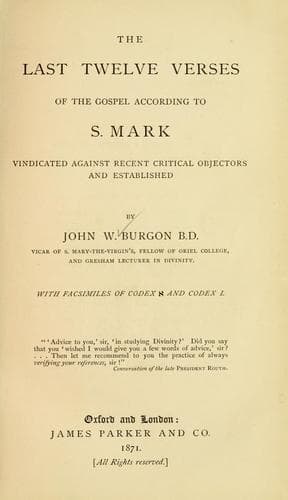
The Last Twelve Verses of the Gospel According to S. MarkBurgon, John William
Religion
The Last Twelve Verses of the Gospel According to S. Mark
Burgon, John William
Bible. Mark XVI, 9-20 -- Criticism, Textual
After this mass of evidence, it will be enough to record concerning the
Armenian version, that it yields inconstant testimony: some of the MSS.
ending at ver. 8; others putting after these words the subscription,
(ἐυαγγέλιον κατὰ Μαρκον,) and then giving the additional verses with a new
subscription: others going on without any break to the end. This version
may be as old as the vth century; but like the Ethiopic [iv-vii?] and the
Georgian [vi?] it comes to us in codices of comparatively recent date. All
this makes it impossible for us to care much for its testimony. The two
last-named versions, whatever their disadvantages may be, at least bear
constant witness to the genuineness of the verses in dispute.
1. And thus we are presented with a mass of additional evidence,—so
various, so weighty, so multitudinous, so venerable,—in support of this
disputed portion of the Gospel, that it might well be deemed in itself
decisive.
2. For these Versions do not so much shew what individuals held, as what
Churches have believed and taught concerning the sacred Text,—mighty
Churches in Syria and Mesopotamia, in Africa and Italy, in Palestine and
Egypt.
3. We may here, in fact, conveniently review the progress which has been
hitherto made in this investigation. And in order to bar the door against
dispute and cavil, let us be content to waive the testimony of Papias as
precarious, and that of Justin Martyr as too fragmentary to be decisive.
Let us frankly admit that the citation of Vincentius à Thibari at the
viith Carthaginian Council is sufficiently inexact to make it unsafe to
build upon it. The “Acta Pilati” and the “Apostolical Constitutions,”
since their date is somewhat doubtful, shall be claimed for the ivth
century only, and not for the iiird. And now, how will the evidence stand
for the last Twelve Verses of S. Mark’s Gospel?
(_a_) In the vth century, to which Codex A and Codex C are referred, (for
Codex D is certainly later,) at least three famous Greeks and the most
illustrious of the Latin Fathers,—(_four_ authorities in all,)—are
observed to recognise these verses.
(_b_) In the ivth century, (to which Codex B and Codex א probably belong,
five Greek writers, one Syriac, and two Latin Fathers,—besides the
Vulgate, Gothic and Memphitic Versions,—(_eleven_ authorities in
all,)—testify to familiar acquaintance with this portion of S. Mark’s
Gospel.
(_c_) In the iiird century, (and by this time MS. evidence has entirely
forsaken us,) we find Hippolytus, the Curetonian Syriac, and the Thebaic
Version, bearing plain testimony that at that early period, in at least
_three_ distinct provinces of primitive Christendom, no suspicion whatever
attached to these verses. Lastly,—
Public-domain text, read in full here on John Shaqi.
Reviews
Reviews
No reviews yet
Be the first to share your thoughts on this work.
Join the Discussion
Join the discussion
Sign in to leave a comment or review.
Sign InorCreate an account