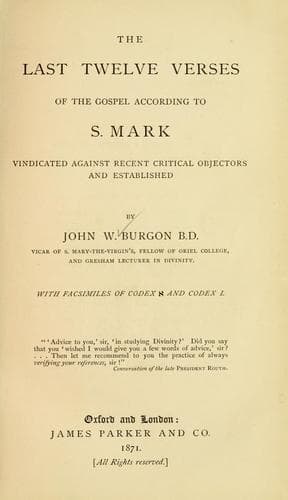
The Last Twelve Verses of the Gospel According to S. MarkBurgon, John William
Religion
The Last Twelve Verses of the Gospel According to S. Mark
Burgon, John William
Bible. Mark XVI, 9-20 -- Criticism, Textual
(_d_) In the iind century, Irenæus, the Peshito, and the Italic Version as
plainly attest that in Gaul, in Mesopotamia and in the African province,
the same verses were unhesitatingly received within a century (more or
less) of the date of the inspired autograph of the Evangelist himself.
4. Thus, we are in possession of the testimony of _at least six_
independent witnesses, of a date considerably anterior to the earliest
extant Codex of the Gospels. They are all of the best class. They deliver
themselves in the most unequivocal way. And their testimony to the
genuineness of these Verses is unfaltering.
5. It is clear that nothing short of direct adverse evidence of the
weightiest kind can sensibly affect so formidable an array of independent
authorities as this. What must the evidence be which shall set it entirely
aside, and induce us to believe, with the most recent editors of the
inspired Text, that the last chapter of S. Mark’s Gospel, as it came from
the hands of its inspired author, ended abruptly at ver. 8?
The grounds for assuming that his “last Twelve Verses” are spurious, shall
be exhibited in the ensuing chapter.
CHAPTER V.
THE ALLEGED HOSTILE WITNESS OF CERTAIN OF THE EARLY FATHERS PROVED TO BE
AN IMAGINATION OF THE CRITICS.
The mistake concerning Gregory of Nyssa (p. 39).—The misconception
concerning Eusebius (p. 41).—The oversight concerning Jerome (p.
51);—also concerning Hesychius of Jerusalem, (or else Severus of
Antioch) (p. 57);—and concerning Victor of Antioch (p. 59).
Public-domain text, read in full here on John Shaqi.
Reviews
Reviews
No reviews yet
Be the first to share your thoughts on this work.
Join the Discussion
Join the discussion
Sign in to leave a comment or review.
Sign InorCreate an account