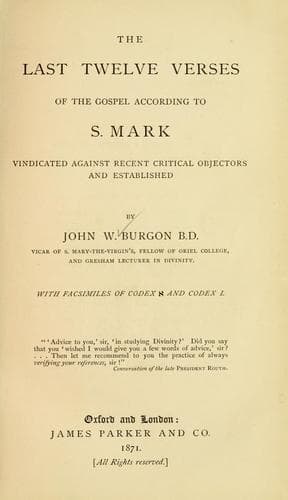
The Last Twelve Verses of the Gospel According to S. MarkBurgon, John William
Religion
The Last Twelve Verses of the Gospel According to S. Mark
Burgon, John William
Bible. Mark XVI, 9-20 -- Criticism, Textual
This illustrious Father is represented as expressing himself as follows in
his second “Homily on the Resurrection;”(69)—“In the more accurate copies,
the Gospel according to Mark has its end at ‘for they were afraid.’ In
some copies, however, this also is added,—‘Now when He was risen early the
first day of the week, He appeared first to Mary Magdalene, out of whom He
had cast seven devils.’ ”
That this testimony should have been so often appealed to as proceeding
from Gregory of Nyssa,(70) is little to the credit of modern scholarship.
One would have supposed that the gravity of the subject,—the importance of
the issue,—the sacredness of Scripture, down to its minutest jot and
tittle,—would have ensured extraordinary caution, and induced every fresh
assailant of so considerable a portion of the Gospel to be very sure of
his ground before reiterating what his predecessors had delivered. And yet
it is evident that not one of the recent writers on the subject can have
investigated this matter for himself. It is only due to their known
ability to presume that had they taken ever so little pains with the
foregoing quotation, they would have found out their mistake.
(1.) For, in the first place, the second “Homily on the Resurrection”
printed in the iiird volume of the works of Gregory of Nyssa, (and which
supplies the critics with their quotation,) is, as every one may see who
will take the trouble to compare them, _word for word the same Homily_
which Combefis in his “Novum Auctarium,” and Gallandius in his
“Bibliotheca Patrum” printed as the work of Hesychius, and vindicated to
that Father, respectively in 1648 and 1776.(71) Now, if a critic chooses
to risk his own reputation by maintaining that the Homily in question is
indeed by Gregory of Nyssa, and is not by Hesychius,—well and good. But
since the Homily can have had but one author, it is surely high time that
one of these two claimants should be altogether dropped from this
discussion.
(2.) Again. Inasmuch as page after page of the same Homily is observed to
reappear, _word for word_, under the name of “Severus of Antioch,” and to
be unsuspiciously printed as his by Montfaucon in his “Bibliotheca
Coisliniana” (1715), and by Cramer in his “Catena”(72) (1844),—although it
may very reasonably become a question among critics whether Hesychius of
Jerusalem or Severus of Antioch was the actual author of the Homily in
question,(73) yet it is plain that critics must make their election
between the two names; and not bring them _both_ forward. No one, I say,
has any right to go on quoting “Severus” _and_ “Hesychius,”—as Tischendorf
and Dr. Davidson are observed to do:—“Gregory of Nyssa” _and_ “Severus of
Antioch,”—as Dr. Tregelles is found to prefer.
Public-domain text, read in full here on John Shaqi.
Reviews
Reviews
No reviews yet
Be the first to share your thoughts on this work.
Join the Discussion
Join the discussion
Sign in to leave a comment or review.
Sign InorCreate an account