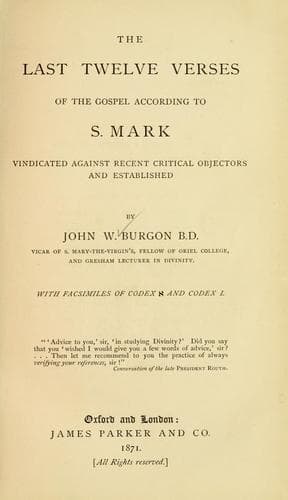
The Last Twelve Verses of the Gospel According to S. Mark — John Shaqi
The Last Twelve Verses of the Gospel According to S. MarkBurgon, John William
Religion
The Last Twelve Verses of the Gospel According to S. Mark
Burgon, John William
Bible. Mark XVI, 9-20 -- Criticism, Textual
(3.) In short, here are three claimants for the authorship of one and the
same Homily. To whichever of the three we assign it,—(and competent judges
have declared that there are sufficient reasons for giving it to Hesychius
rather than to Severus,—while _no one_ is found to suppose that Gregory of
Nyssa was its author,)—_who_ will not admit that no further mention must
be made of the other two?
(4.) Let it be clearly understood, therefore, that henceforth the name of
“Gregory of Nyssa” must be banished from this discussion. So must the name
of “Severus of Antioch.” The memorable passage which begins,—“In the more
accurate copies, the Gospel according to Mark has its end at ‘for they
were afraid,’ ”—is found in _a Homily which was probably written by
Hesychius, presbyter of Jerusalem,—a writer of the vi_th_ century_. I
shall have to recur to his work by-and-by. The next name is
EUSEBIUS,
II. With respect to whom the case is altogether different. What that
learned Father has delivered concerning the conclusion of S. Mark’s Gospel
requires to be examined with attention, and must be set forth much more in
detail. And yet, I will so far anticipate what is about to be offered, as
to say at once that if any one supposes that Eusebius has anywhere plainly
“stated that it is _wanted in many MSS._,”(74)—he is mistaken. Eusebius
nowhere says so. The reader’s attention is invited to a plain tale.
It was not until 1825 that the world was presented by Cardinal Angelo
Mai(75) with a few fragmentary specimens of a lost work of Eusebius on the
(so-called) Inconsistencies in the Gospels, from a MS. in the Vatican.(76)
These, the learned Cardinal republished more accurately in 1847, in his
“Nova Patrum Bibliotheca;”(77) and hither we are invariably referred by
those who cite Eusebius as a witness against the genuineness of the
concluding verses of the second Gospel.
Public-domain text, read in full here on John Shaqi.
Reviews
Reviews
No reviews yet
Be the first to share your thoughts on this work.
Join the Discussion
Join the discussion
Sign in to leave a comment or review.
Sign InorCreate an account