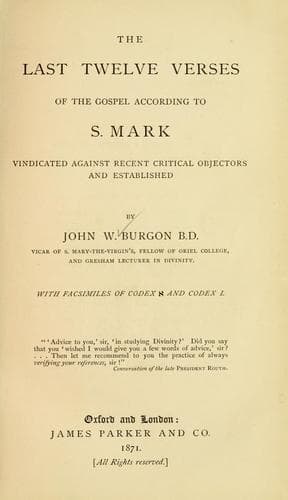
The Last Twelve Verses of the Gospel According to S. MarkBurgon, John William
Religion
The Last Twelve Verses of the Gospel According to S. Mark
Burgon, John William
Bible. Mark XVI, 9-20 -- Criticism, Textual
1. Let it be freely admitted that what precedes is calculated at first
sight to occasion nothing but surprise and perplexity. For, in the first
place, there really is _no problem to solve_. The discrepancy suggested by
“Marinus” at the outset, is plainly imaginary, the result (chiefly) of a
strange misconception of the meaning of the Evangelist’s Greek,—as in fact
no one was ever better aware than Eusebius himself. “These places of the
Gospels would never have occasioned any difficulty,” he writes in the very
next page, (but it is the commencement of his reply to the _second_
question of Marinus,)—“if people would but abstain from assuming that
Matthew’s phrase (ὀψὲ σαββάτων) refers to _the evening of the
Sabbath-day_: whereas, (in conformity with the established idiom of the
language,) it obviously refers to an advanced period of the ensuing
night.”(88) He proceeds:—“The self-same moment therefore, or very nearly
the self-same, is intended by the Evangelists, only under different names:
and there is no discrepancy whatever between Matthew’s,—‘in the end of the
Sabbath, as it began to dawn toward the first day of the week,’ and
John’s—‘The first day of the week cometh Mary Magdalen early, when it was
yet dark.’ The Evangelists indicate by different expressions one and the
same moment of time, but in a broad and general way.” And yet, if Eusebius
knew all this so well, why did he not say so at once, and close the
discussion? I really cannot tell; except on one hypothesis,—which,
although at first it may sound somewhat extraordinary, the more I think of
the matter, recommends itself to my acceptance the more. I suspect, then,
that the discussion we have just been listening to, is, essentially, _not
an original production_: but that Eusebius, having met with the suggestion
in some older writer, (in Origen probably,) reproduced it in language of
his own,—doubtless because he thought it ingenious and interesting, but
not by any means because he regarded it as true. Except on some such
theory, I am utterly unable to understand how Eusebius can have written so
inconsistently. His admirable remarks just quoted, are obviously a full
and sufficient answer,—the proper answer in fact,—to the proposed
difficulty: and it is a memorable circumstance that the ancients generally
were so sensible of this, that they are found to have _invariably_(89)
substituted what Eusebius wrote in reply to the _second_ question of
Marinus for what he wrote in reply to _the first_; in other words, for the
dissertation which is occasioning us all this difficulty.
Public-domain text, read in full here on John Shaqi.
Reviews
Reviews
No reviews yet
Be the first to share your thoughts on this work.
Join the Discussion
Join the discussion
Sign in to leave a comment or review.
Sign InorCreate an account