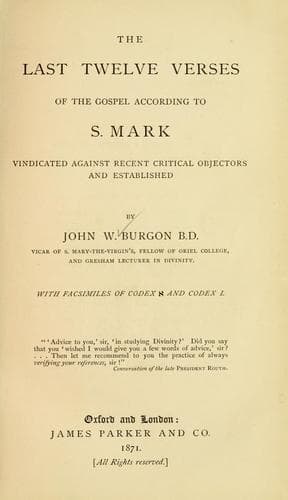
The Last Twelve Verses of the Gospel According to S. MarkBurgon, John William
Religion
The Last Twelve Verses of the Gospel According to S. Mark
Burgon, John William
Bible. Mark XVI, 9-20 -- Criticism, Textual
2. But next, even had the discrepancy been real, the remedy for it which
is here proposed, and which is advocated with such tedious emphasis, would
probably prove satisfactory to no one. In fact, the entire method
advocated in the foregoing passage is hopelessly vicious. The writer
begins by advancing statements which, if he believed them to be true, he
must have known are absolutely fatal to the verses in question. This done,
he sets about discussing the possibility of reconciling an isolated
expression in S. Mark’s Gospel with another in S. Matthew’s: just as if on
_that_ depended the genuineness or spuriousness of the entire context: as
if, in short, the major premiss in the discussion were some such postulate
as the following:—“Whatever in one Gospel cannot be proved to be entirely
consistent with something in another Gospel, is not to be regarded as
genuine.” Did then the learned Archbishop of Cæsarea really suppose that a
comma judiciously thrown into the empty scale might at any time suffice to
restore the equilibrium, and even counterbalance the adverse testimony of
almost every MS. of the Gospels extant? Why does he not at least deny the
truth of the alleged facts to which he began by giving currency, if not
approval; and which, so long as they are allowed to stand uncontradicted,
render all further argumentation on the subject simply nugatory? As
before, I really cannot tell,—except on the hypothesis which has been
already hazarded.
3. Note also, (for this is not the least extraordinary feature of the
case,) what vague and random statements those are which we have been
listening to. The entire section (S. Mark xvi. 9-20,) “_is not met with in
all_ the copies:” at all events _not_ “_in the accurate_” ones. Nay, it is
“_met with seldom_.” In fact, it is _absent from_ “_almost all_” copies.
But,—Which of these four statements is to stand? The first is
comparatively unimportant. Not so the second. The last two, on the
contrary, would be absolutely fatal,—if trustworthy? But _are_ they
trustworthy?
Public-domain text, read in full here on John Shaqi.
Reviews
Reviews
No reviews yet
Be the first to share your thoughts on this work.
Join the Discussion
Join the discussion
Sign in to leave a comment or review.
Sign InorCreate an account