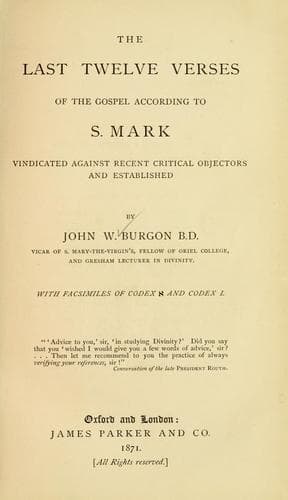
The Last Twelve Verses of the Gospel According to S. MarkBurgon, John William
Religion
The Last Twelve Verses of the Gospel According to S. Mark
Burgon, John William
Bible. Mark XVI, 9-20 -- Criticism, Textual
Are we then to suppose that there was no substratum of truth in the
allegations to which Eusebius gives such prominence in the passage under
discussion? By no means. The mutilated state of S. Mark’s Gospel in the
Vatican Codex (B) and especially in the Sinaitic Codex (א) sufficiently
establishes the contrary. Let it be freely conceded, (but in fact it has
been freely conceded already,) that there must have existed in the time of
Eusebius _many_ copies of S. Mark’s Gospel which were without the twelve
concluding verses. I do but insist that there is nothing whatever in that
circumstance to lead us to entertain one serious doubt as to the
genuineness of these verses. I am but concerned to maintain that there is
nothing whatever in the evidence which has hitherto come before
us,—certainly not _in the evidence of Eusebius_,—to induce us to believe
that they are a spurious addition to S. Mark’s Gospel.
III. We have next to consider what
JEROME
has delivered on this subject. So great a name must needs command
attention in any question of Textual Criticism: and it is commonly
pretended that Jerome pronounces emphatically against the genuineness of
the last twelve verses of the Gospel according to S. Mark. A little
attention to the actual testimony borne by this Father will, it is
thought, suffice to exhibit it in a wholly unexpected light; and induce us
to form an entirely different estimate of its practical bearing upon the
present discussion.
It will be convenient that I should premise that it is in one of his many
exegetical Epistles that Jerome discusses this matter. A lady named
Hedibia, inhabiting the furthest extremity of Gaul, and known to Jerome
only by the ardour of her piety, had sent to prove him with hard
questions. He resolves her difficulties from Bethlehem:(90) and I may be
allowed to remind the reader of what is found to have been Jerome’s
practice on similar occasions,—which, to judge from his writings, were of
constant occurrence. In fact, Apodemius, who brought Jerome the Twelve
problems from Hedibia, brought him Eleven more from a noble neighbour of
hers, Algasia.(91) Once, when a single messenger had conveyed to him out
of the African province a quantity of similar interrogatories, Jerome sent
two Egyptian monks the following account of how he had proceeded in
respect of the inquiry,—(it concerned 1 Cor. xv. 51,)—which they had
addressed to him:—“Being pressed for time, I have presented you with the
opinions of all the Commentators; for the most part, translating their
very words; in order both to get rid of your question, and to put you in
possession of ancient authorities on the subject.” This learned Father
does not even profess to have been in the habit of delivering his own
opinions, or speaking his own sentiments on such occasions. “This has been
hastily dictated,” he says in conclusion,—(alluding to his constant
practice, which was to dictate, rather than to write,)—“in order that I
Public-domain text, read in full here on John Shaqi.
Reviews
Reviews
No reviews yet
Be the first to share your thoughts on this work.
Join the Discussion
Join the discussion
Sign in to leave a comment or review.
Sign InorCreate an account