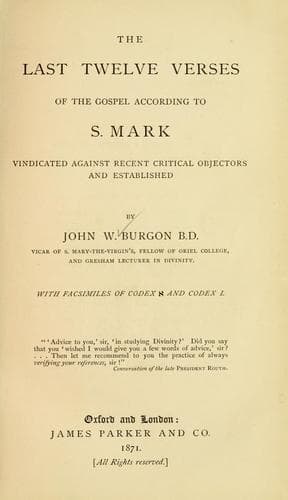
The Last Twelve Verses of the Gospel According to S. Mark — John Shaqi
The Last Twelve Verses of the Gospel According to S. MarkBurgon, John William
Religion
The Last Twelve Verses of the Gospel According to S. Mark
Burgon, John William
Bible. Mark XVI, 9-20 -- Criticism, Textual
And yet the author of the exaggeration under review, be it observed, is
clearly _not Eusebius_. It is evident that _he_ has nothing to say against
the genuineness of the conclusion of S. Mark’s Gospel. Those random
statements about the copies with which he began, do not even purport to
express his own sentiments. Nay, Eusebius in a manner repudiates them; for
he introduces them with a phrase which separates them from himself: and,
“This then is what a person will say,”—is the remark with which he finally
dismisses them. It would, in fact, be to make this learned Father stultify
himself to suppose that he proceeds gravely to discuss a portion of
Scripture which he had already deliberately rejected as spurious. But,
indeed, the evidence before us effectually precludes any such supposition.
“Here are two readings,” he says, “(as is so often the case elsewhere:)
_both_ of which are to be received,—inasmuch as by the faithful and pious,
_this_ reading is not held to be genuine rather than _that_; nor _that_
than _this_.” And thus we seem to be presented with the actual opinion of
Eusebius, as far as it can be ascertained from the present passage,—if
indeed he is to be thought here to offer any personal opinion on the
subject at all; which, for my own part, I entirely doubt. But whether we
are at liberty to infer the actual sentiments of this Father from anything
here delivered or not, quite certain at least is it that to print only the
first half of the passage, (as Tischendorf and Tregelles have done,) and
then to give the reader to understand that he is reading the adverse
testimony of Eusebius as to the genuineness of the end of S. Mark’s
Gospel, is nothing else but to misrepresent the facts of the case; and,
however unintentionally, to deceive those who are unable to verify the
quotation for themselves.
It has been urged indeed that Eusebius cannot have recognised the verses
in question as genuine, because a scholium purporting to be his has been
cited by Matthaei from a Catena at Moscow, in which he appears to assert
that “according to Mark,” our SAVIOUR “is not recorded to have appeared to
His Disciples after His Resurrection:” whereas in S. Mark xvi. 14 it is
plainly recorded that “Afterwards He appeared unto the Eleven as they sat
at meat.” May I be permitted to declare that I am distrustful of the
proposed inference, and shall continue to feel so, until I know something
more about the scholium in question? Up to the time when this page is
printed I have not succeeded in obtaining from Moscow the details I wish
for: but they must be already on the way, and I propose to embody the
result in a “Postscript” which shall form the last page of the Appendix to
the present volume.
Public-domain text, read in full here on John Shaqi.
Reviews
Reviews
No reviews yet
Be the first to share your thoughts on this work.
Join the Discussion
Join the discussion
Sign in to leave a comment or review.
Sign InorCreate an account