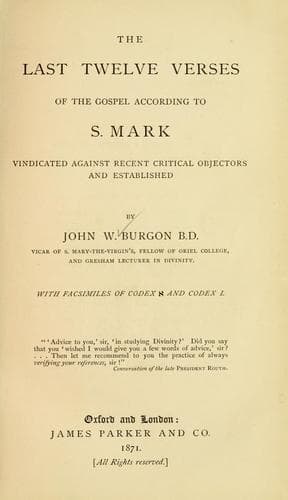
The Last Twelve Verses of the Gospel According to S. MarkBurgon, John William
Religion
The Last Twelve Verses of the Gospel According to S. Mark
Burgon, John William
Bible. Mark XVI, 9-20 -- Criticism, Textual
Tischendorf,—the illustrious discoverer and champion of Codex א, and who
is accustomed to appeal triumphantly to its omission of the words ἐν Ἐφέσῳ
as _the other_ conclusive proof of the trustworthiness of its text,—may be
presumed to be the most able advocate it is likely to meet with, as well
as the man best acquainted with what is to be urged in its support. From
him, we learn that the evidence for the omission of the words in question
is as follows:—“In the beginning of the Epistle to the Ephesians we read,
‘to the saints which are at Ephesus;’ but Marcion (A.D. 130-140), did not
find the words ‘at Ephesus’ in his copy. The same is true of Origen (A.D.
185-254); and Basil the Great (who died A.D. 379), affirmed that those
words were wanting in _old_ copies. And this omission accords very well
with the encyclical or general character of the Epistle. At the present
day, our ancient Greek MSS., and all ancient Versions, contain the words
‘at Ephesus;’ yea (_sic_), even Jerome knew no copy with a different
reading. Now, only the Sinaitic and the Vatican correspond with the _old_
copies of Basil, and those of Origen and Marcion.”(152)—This then is the
sum of the evidence. Proceed we to examine it somewhat in detail.
(1) And first, I take leave to point out that the learned writer is
absolutely without authority for his assertion that “Marcion _did not
find_ the words ἐν Ἐφέσῳ in his copy” of S. Paul’s Epistle to the
Ephesians. Tischendorf’s one pretence for saying so is Tertullian’s
statement that certain heretics, (Marcion he specifies by name,) had given
to S. Paul’s “Epistle to the Ephesians” the unauthorized title of “Epistle
_to the Laodiceans_.”(153) This, (argues Tischendorf,) Marcion could not
have done had he found ἐν Ἐφέσῳ in the first verse.(154) But the proposed
inference is clearly invalid. For, with what show of reason can
Marcion,—whom Tertullian taxes with having dared “_titulum interpolare_”
in the case of S. Paul’s “Epistle to the Ephesians,”—be _therefore_,
assumed to have read the first verse differently from ourselves? Rather is
the directly opposite inference suggested by the very language in which
Tertullian (who was all but the contemporary of Marcion) alludes to the
circumstance.(155)
Public-domain text, read in full here on John Shaqi.
Reviews
Reviews
No reviews yet
Be the first to share your thoughts on this work.
Elsewhere in the archive
Join the Discussion
Join the discussion
Sign in to leave a comment or review.
Sign InorCreate an account