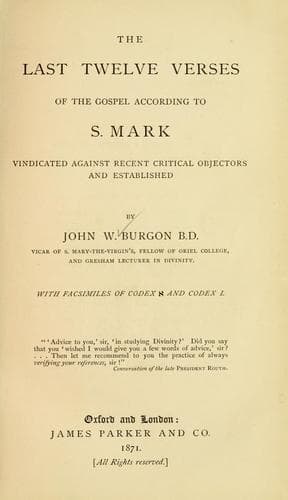
The Last Twelve Verses of the Gospel According to S. MarkBurgon, John William
Religion
The Last Twelve Verses of the Gospel According to S. Mark
Burgon, John William
Bible. Mark XVI, 9-20 -- Criticism, Textual
Those, however, who would really understand the work of the heretic,
should turn from the African Father,—(who after all does but say that
Marcion and his crew feigned concerning S. Paul’s Epistle to the
_Ephesians_, that it was addressed to the _Laodiceans_,)—and betake
themselves to the pages of Epiphanius, who lived about a century and a
half later. This Father had for many years made Marcion’s work his special
study,(156) and has elaborately described it, as well as presented us with
copious extracts from it.(157) And the account in Epiphanius proves that
Tischendorf is mistaken in the statement which he addresses to the English
reader, (quoted above;) and that he would have better consulted for his
reputation if he had kept to the “ut videtur” with which (in his edition
of 1859) he originally broached his opinion. It proves in fact to be no
matter of opinion at all. Epiphanius states distinctly that the _Epistle
to the Ephesians_ was one of the ten Epistles of S. Paul which Marcion
_retained_. In his “Apostolicon,” or collection of the (mutilated)
Apostolical Epistles, the “Epistle to the Ephesians,” (identified by the
considerable quotations which Epiphanius makes from it,(158)) stood (he
says) _seventh_ in order; while the (so called) “Epistle to the
Laodiceans,”—a distinct composition therefore,—had the _eleventh_, that
is, the last place assigned to it.(159) That this latter Epistle contained
a corrupt exhibition of Ephes. iv. 5 is true enough. Epiphanius records
the fact in two places.(160) But then it is to be borne in mind that he
charges Marcion with having derived that quotation _from the Apocryphal
Epistle to the Laodiceans_;(161) instead of taking it, as he ought to have
done, from the genuine Epistle to the Ephesians. The passage, when
faithfully exhibited, (as Epiphanius points out,) by its very form refutes
the heretical tenet which the context of Marcion’s spurious epistle to the
Laodiceans was intended to establish; and which the verse in question, in
its interpolated form, might seem to favour.(162)—I have entered into this
whole question more in detail perhaps than was necessary: but I was
determined to prove that Tischendorf’s statement that “Marcion (A.D.
130-140) did not find the words ‘at Ephesus’ in his copy,”—is absolutely
without foundation. It is even _contradicted_ by the known facts of the
case. I shall have something more to say about Marcion by-and-by; who, it
is quite certain, read the text of Ephes. i. 1 exactly as we do.
Public-domain text, read in full here on John Shaqi.
Reviews
Reviews
No reviews yet
Be the first to share your thoughts on this work.
Elsewhere in the archive
Join the Discussion
Join the discussion
Sign in to leave a comment or review.
Sign InorCreate an account