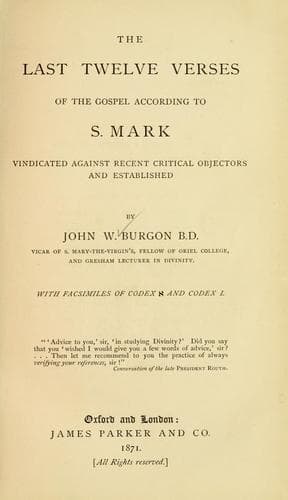
The Last Twelve Verses of the Gospel According to S. MarkBurgon, John William
Religion
The Last Twelve Verses of the Gospel According to S. Mark
Burgon, John William
Bible. Mark XVI, 9-20 -- Criticism, Textual
(2.) The _only_ Father who so expresses himself as to warrant the
inference that the words ἐν Ἐφέσῳ were absent from his copy, is Origen, in
the beginning of the third century. “Only in the case of the Ephesians,”
(he writes), “do we meet with the expression ‘the Saints which are:’ and
we inquire,—Unless that additional phrase be simply redundant, what can it
possibly signify? Consider, then, whether those who have been partakers of
_His_ nature who revealed Himself to Moses by the Name of I AM, may not,
in consequence of such union with Him, be designated as ‘those _which
are_:’ persons, called out, of a state of _not_-being, so to speak, into a
state of _being_.”(163)—If Origen had read τοῖς ἁγίοις τοῖς οὖσιν ἐν Ἐφέσῳ
in his copy, it is to me incredible that he would have gone so very far
out of his way to miss the sense of such a plain, and in fact,
unmistakable an expression. Bishop Middleton, and Michaelis before
him,—_reasoning however only from the place in Basil,_ (to be quoted
immediately,)—are unwilling to allow that the words ἐν Ἐφέσῳ were ever
away from the text. It must be admitted as the obvious inference from what
Jerome has delivered on this subject (_infrà_, p. 98 _note_) that he, too,
seems to know nothing of the reading (if reading it can be called) of
Codd. B and א.
(3) The influence which Origen’s writings exercised over his own and the
immediately succeeding ages of the Church, was prodigious. Basil, bishop
of Cæsarea in Cappadocia, writing against the heresy of Eunomius about 150
years later,—although he read ἐν Ἐφέσῳ in his own copy of S. Paul’s
Epistles,—thought fit to avail himself of Origen’s suggestion. It suited
his purpose. He was proving the eternal existence of the SON of GOD. Even
_not to know_ GOD (he remarks) is _not to be_: in proof of which, he
quotes S. Paul’s words in 1 Cor. i. 28:—“Things _which are not_, hath GOD
chosen.” “Nay,” (he proceeds,) the same S. Paul, “in his Epistle to the
Ephesians, inasmuch as he is addressing persons who by intimate knowledge
were truly joined to Him who ‘IS,’ designates them specially as ‘those
_which are_:’ saying,—‘To the Saints _which are_, and faithful in CHRIST
JESUS.’ ” That this fancy was not original, Basil makes no secret. He
derived it, (he says,) from “those who were before us;” a plain allusion
to the writings of Origen. But neither was _the reading_ his own, either.
This is evident. He had _found_ it, he says,—(an asseveration
indispensable to the validity of his argument,)—but only after he had made
search,(164)—“_in the old copies_.”(165) No doubt, Origen’s strange fancy
must have been even _unintelligible_ to Basil when first he met with it.
In plain terms, it sounds to this day incredibly foolish,—when read apart
from the mutilated text which alone suggested it to Origen’s fervid
imagination.—But what there is in all this to induce us to suspect that
Origen’s reading was after all the _right_ one, and _ours_ the _wrong_, I
Public-domain text, read in full here on John Shaqi.
Reviews
Reviews
No reviews yet
Be the first to share your thoughts on this work.
Elsewhere in the archive
Join the Discussion
Join the discussion
Sign in to leave a comment or review.
Sign InorCreate an account