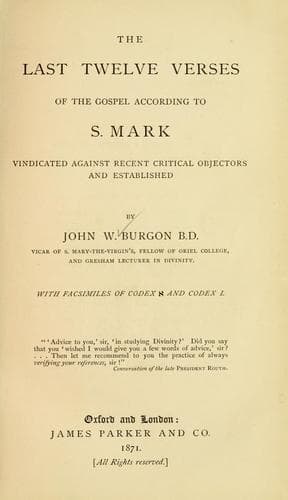
The Last Twelve Verses of the Gospel According to S. MarkBurgon, John William
Religion
The Last Twelve Verses of the Gospel According to S. Mark
Burgon, John William
Bible. Mark XVI, 9-20 -- Criticism, Textual
profess myself wholly at a loss to discover. Origen himself complains
bitterly of the depraved state of the copies in his time; and attributes
it (1) to the carelessness of the scribes: (2) to the rashness of
correctors of the text: (3) to the licentiousness of individuals, adopting
some of these corrections and rejecting others, according to their own
private caprice.(166)
(4) Jerome, a man of severer judgment in such matters than either Origen
or Basil, after rehearsing the preceding gloss, (but only to reject it,)
remarks that “certain persons” had been “over-fanciful” in putting it
forth. He alludes probably to Origen, whose Commentary on the Ephesians,
in three books, he expressly relates that he employed:(167) but he does
not seem to have apprehended that Origen’s text _was without the words_ ἐν
Ἐφέσῳ. If he was acquainted with Origen’s text, (of which, however, his
writings afford no indication,) it is plain that he disapproved of it.
Others, he says, understand S. Paul to say not “the Saints _which are_:”
but,—“the Saints and faithful _which are at Ephesus_.”(168)
(5) The witnesses have now all been heard: and I submit that there has
been elicited from their united evidence nothing at all calculated to
shake our confidence in the universally received reading of Ephesians i.
1. The facts of the case are so scanty that they admit of being faithfully
stated in a single sentence. Two MSS. of the ivth century, (exhibiting in
other respects several striking notes of vicious sympathy,) are found to
conspire in omitting a clause in Ephesians i. 1, which, (necessary as it
is to the sense,) may be inferred to have been absent from Origen’s copy:
and Basil testifies that it was absent from “the old copies” to which he
himself obtained access. This is really the whole of the matter: in which
it is much to be noted that Origen does not say that he _approved_ of this
reading. Still less does Basil. They both witness to _the fact_ that the
words ἐν Ἐφέσῳ were omitted from _some_ copies of the iiird century, just
as Codd. B and א witness to the same fact in the ivth. But what then?
Origen is known occasionally to go out of his way to notice readings
confessedly worthless; and, why not here? For not only is the text all but
_unintelligible_ if the words ἐν Ἐφέσῳ be omitted: but (what is far more
to the purpose) the direct evidence of _all_ the copies, whether uncial or
cursive,(169)—and of _all_ the Versions,—is _against_ the omission. In the
face of this overwhelming mass of unfaltering evidence to insist that
Codd. B and א must yet be accounted right, and all the rest of Antiquity
wrong, is simply irrational. To uphold the authority, in respect of this
nonsensical reading, of _two_ MSS. confessedly untrustworthy in countless
other places,—against _all_ the MSS.—_all_ the Versions,—is nothing else
but an act of vulgar prejudice. I venture to declare,—(and with this I
shall close the discussion and dismiss the subject,)—that _there does not
Public-domain text, read in full here on John Shaqi.
Reviews
Reviews
No reviews yet
Be the first to share your thoughts on this work.
Elsewhere in the archive
Join the Discussion
Join the discussion
Sign in to leave a comment or review.
Sign InorCreate an account