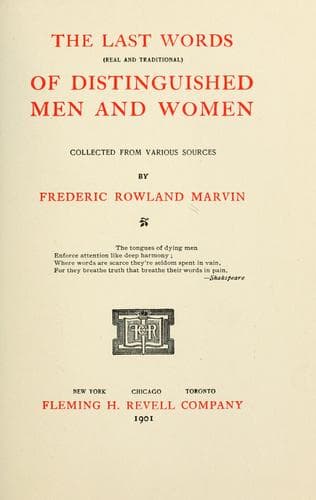
The Last Words (Real and Traditional) of Distinguished Men and WomenMarvin, Frederic Rowland
History
The Last Words (Real and Traditional) of Distinguished Men and Women
Marvin, Frederic Rowland
Last words
Shortly before Frances Willard's death she took notice of Hoffman's
picture of Christ on the wall, which had been given to her by Lady Henry
Somerset, and directed that it be taken back to Lady Henry with this
inscription: "Only the golden rule of Christ can bring the golden age of
man." Her last words were "How beautiful to be with God."
_Rev. C. C. Carpenter._
WILLIAM I. (of England, surnamed "The Conqueror"), 1025-1087. "_I
commend myself to the blessed Lady Mary, hoping by her intercessions to
be reconciled to her most dear Son, our Lord Jesus Christ._"
WILLIAM III. (of England), 1650-1702. "_Can this last long?_" to his
physician.
WILMOT (John, Earl of Rochester, witty and profligate courtier and
author, and a great favorite with Charles II. Notwithstanding his evil
life, he was a brave soldier and had many attractive qualities),
1647-1680. "_The only objection against the Bible is a bad life._"
WILSON (Alexander, distinguished ornithologist), 1766-1813. His last
words are not recorded, but just before his death he asked to be buried
where the birds might sing over his grave.[53]
[53] Walter von der Vogelweid requested that he might repose where a
leafy tree should cast its shadow, and the light of the summer day
should linger long; and that the birds might be fed every day from
the stone over his grave. See Longfellow's beautiful poem, "Walter
von der Vogelweid."
WINKELRIED (Arnold von, Swiss patriot who broke the Austrian phalanx at
the battle of Sempach in 1385, by rushing against the points of their
spears, and gathering within his arms as many as he could. He fell
pierced with many wounds, but the Swiss were victorious). "_Friends, I
am going to lay down my life to procure you victory. All I request is
that you provide for my family. Follow me and imitate my example._"
A column surmounted by a lion, erected on the five hundredth anniversary
of the victory marks the spot where Arnold von Winkelried fell.
WISHART (George), 1502-1546. "_For the sake of the true gospel, given
one by the grace of God, I suffer this day with a glad heart. Behold and
consider my visage. Ye shall not see me change color. I fear not this
fire._" He was burned at the stake for preaching the doctrines of the
Reformation.
A few moments before he uttered his last words the executioner said to
him, "Sir, I pray you to forgive me, for I am not guilty of your death,"
to which the martyr, having replied, "Come hither to me," and then
kissed him on the cheek, said: "Lo, here is a token that I forgive
thee."
WITT (Cornelius de). "This man, who had bravely served his country in
war, and who had been invested with the highest dignities, was delivered
into the hands of the executioner, and torn in pieces by the most
inhuman torments. Amidst the severe agonies which he endured he
frequently repeated an ode of Horace,[54] which contained sentiments
suited to his deplorable condition."--_Hume._
Public-domain text, read in full here on John Shaqi.
Reviews
Reviews
No reviews yet
Be the first to share your thoughts on this work.
Elsewhere in the archive
Join the Discussion
Join the discussion
Sign in to leave a comment or review.
Sign InorCreate an account