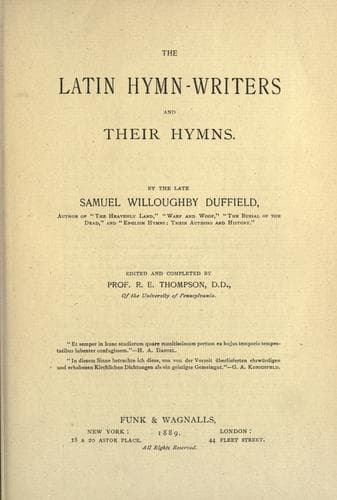
The Latin Hymn-writers and Their HymnsDuffield, Samuel Willoughby
Religion
The Latin Hymn-writers and Their Hymns
Duffield, Samuel Willoughby
Hymns, Latin -- History and criticism
It may be said, and with truth, that the _Magnificat_ of Mary, the _Nunc
Dimittis_ of old Simeon, and, above all, that the _Gloria in Excelsis
Deo_ of the angels at Bethlehem, antedate this hymn of our Lord and His
apostles. It may also be said, and with the same truth, that these
furnished to the early Christians their earliest expressions of praise.
But it appears that the Last Supper, with its pathetic union of Jewish
and Christian ideas, was also the place at which the Psalms of David and
the spiritual songs of primitive Christianity were united. The thought
that this reveals is larger than these limits will permit us to discuss.
It is in brief that as Jesus Christ came, “not to destroy, but to
fulfil,” He designed to show to His Church that gratitude, love, trust,
and adoration were to be combined in all future psalmody. The _t’hillim_
of the Jew were to become the _hymni_ of the Christian.
The noticeable fact remains that the early Church only caught the
simplest and most fervent forms of this worship. Their pure veneration
of the Lord led Pliny to write (Ep. 10:97) that they “sung alternately
among themselves a hymn to Christ as God”—_carmen Christo quasi Deo,
dicere secum invicem_. It is this loving devotion which charms us as we
read those verses which have been preserved. For the most part the
subjects are limited. We could naturally expect that, being largely
drawn from Jewish sources, they would express gratitude and
adoration—and this is correct. Chrysostom declared that the early
Christians sung at prayers in the morning, at their work, and very
usually at their meals. Jerome, writing to Marcellus, says—and we quote
Cave’s translation for its quaintness—“You could not go into the field
but you might hear the _Ploughman_ at his _Hallelujahs_, the _Mower_ at
his _Hymns_, and the _Vine-dresser_ singing _David’s Psalms_.” In fact,
Christian song was a notable feature of primitive Christianity.
The language of these hymns was either Syriac or Greek. By degrees the
Greek obtained the precedence; and as the Latin hymns did not arise
until Hilary of Poitiers (fourth century), the period between the
Ascension and that era belongs to the Greek language rather more than to
any other. We also know from the New Testament writers some very
important facts, which may properly be classified at this point.
1. There were three terms for the sacred song. It might be a _psalm_, or
a _hymn_, or a _spiritual song_, as we discover from Ephesians 5:19 and
Colossians 3:16.
Public-domain text, read in full here on John Shaqi.
Reviews
Reviews
No reviews yet
Be the first to share your thoughts on this work.
Join the Discussion
Join the discussion
Sign in to leave a comment or review.
Sign InorCreate an account